Kristof comes close here. He "gets" it, like in his last piece, but his closing exhortation that "we can do better!" is moronic.
Again, the intellectual conceit rears its ugly head. One liners like that at the end of the piece miss the point. Nothing is going to happen. No interested party is going to police themselves when there is no real accountability anywhere.
The Republicans know this; that's why they don't bother trying to control people. It's a less rosy view on human nature, to be sure, but it's one that's not buried in denial the way Kristof's is.
Still it's nice to hear that experts have no idea what they're talking about. Being an expert myself at so many things, I've known this for years. But people looove to look to experts to tell them what is and what isn't. People love to be led, which is why the founders of this country wrote obsessively about the need for vigilance when confronting tyranny. What many of them were unable to see, however, blinded by the enlightenment, was that the tyranny on the outside isn't nearly so dangerous as the servitude and passivity on the inside.
Tyrants don't just pop out of nowhere- they are the expression of the collective will every bit as much as an elected president. The difference is that the president can get voted out after a while and so is more on guard to public sentiment than the tyrant who rules by the sword.
But democracy or not, we still have tyrants everywhere. They've just moved out of government and into science, education, and medicine. These are the people who tell us all what to do- even the presidents. They are experts who rule by the study rather than monarchs who rule by the blade. But the effect on people is no different. It is arbitrary enslavement.
As for me, I've more or less stopped minding this. Truth is squishy, and there's no sense in trying to flatten it out. That's not what it's there for. Truth is ammunition and can be fabricated and manufactured to fit any weapon. It is only the pre-programmed biases of the observer that interfere with his being shot down (by a particular argument). Being pre-programmed, however, the observer is almost never aware of this, and so he receives the expert's "wisdom" as if it were truth.
And round and round it goes. . .why not take a ride? People will believe anything.
Thursday, March 26, 2009

Tuesday, March 24, 2009
MC
A quick plug:
My new friend Mac is an unusual fellow. He is actually the character that broke the back of my idea to give up and start writing a blog about all of the weird people I know and have met over the years.
Mac Kohler is an enigmatic polymath and the one person I know who I might actually admit in public to being smarter than me.
So we have a good time. The story of how I met Mac is an interesting one, but I will save it for another time. As will I some of Mac's more fascinating quirks and talents.
But I am posting a link to a lovely post on his blog. The topic of "Rope Springs Eternal" is mainly the art and play of bondage, which I feel probably lies without the scope of this blog. But this particular story has more to do with nature itself, and I find it a good read without reference to Mac's other "passions." (that's a double entendre, not a slur)
So please enjoy, and say hello to Mac's blog for me. If you can remember what the operative verb is by the time you get to the end of a given sentence, you will have a good time.
So long for now.
My new friend Mac is an unusual fellow. He is actually the character that broke the back of my idea to give up and start writing a blog about all of the weird people I know and have met over the years.
Mac Kohler is an enigmatic polymath and the one person I know who I might actually admit in public to being smarter than me.
So we have a good time. The story of how I met Mac is an interesting one, but I will save it for another time. As will I some of Mac's more fascinating quirks and talents.
But I am posting a link to a lovely post on his blog. The topic of "Rope Springs Eternal" is mainly the art and play of bondage, which I feel probably lies without the scope of this blog. But this particular story has more to do with nature itself, and I find it a good read without reference to Mac's other "passions." (that's a double entendre, not a slur)
So please enjoy, and say hello to Mac's blog for me. If you can remember what the operative verb is by the time you get to the end of a given sentence, you will have a good time.
So long for now.
This makes me laugh so hard I fall out of my chair
"Uh, U-huh." - that's what makes it art.
Literally, it's been like 20 times, and it still cracks me up.
Saturday, March 14, 2009
Quick critique
I'd say that one paragraph in the middle about the system not being broken could use some elaboration. Under the current system there really is no way to know that the good ideas move forward and the lesser ones get trampled. The open democratic review allowed to government is the only real way to approach a larger "truth."
The author hints at this in his final paragraph- that we must discover our "inner" scientists. That doing this on the scale required to adequately judge science's results is practically speaking impossible. No single person has access to the body of materials (to say nothing of the time) to conduct all the experiments required to make an informed judgment - that is why it is so insidious.
Perhaps a version of "League of Women Voters" could emerge to challenge scientific dogma on behalf of the voter/scientific recipient. But such interest groups would lack a core constituency the way AARP or the Sierra Club do, for example.
The real solution is to dispense with the illusion of scientific truth in the first place and find some other more subjective anchoring for our world view. As I mentioned above, the "truth" arrived at by science is only temporary anyway- so far there have been no scientific experiments that have not been undermined by some later ones. The terminus of that sequence of undermining comes in the quantum physics movement which suggests that our experience is, in fact, at least as subjective as it is objective (as ying as yang, you could say). Yet we persist in the delusion of "eternal objectivity" which is science's claim on "truth" and therefore authority.
This is the where the system is, in fact, broken, just as the Medieval "indulgences" indicated the brokenness of the old Catholic system of truth. The West favors the masculine over feminine - "truth" over subjectivity. This is so much a part of our culture that when we decide to 'liberate' women, we allow them to be formed only in the model of men. We do not honor their changeable subjectivity in its own right. The prejudice is do ingrained in our culture that we hardly even see it as such, but rather convince ourselves that it is a moral virtue to be non-feminine, orderly, "correct," and rational. It would almost seem immoral to Westerners to value such things as chaos, irrationality, and subjectivity. Yet taken to the extreme, our masculine-driven scientific machine shows itself to be wholly subjective, confused, and irrational.
This is the classic Chinese case for balance, as the Yang cedes to the Ying in its extreme. We, having little or no place for the Ying, have nothing for the Yang to flow into, and so it just breaks, as science has already broken.
As you can imagine, if we were to all of a sudden "dispense" with science, what would emerge under our feet would be total chaos. We have so linked our fate to the fashions of the university mind that we are lost without them. So we will fight to maintain our system and further harden the yang principle against the ying until nature simply rebels uncontrollably and balance is restored.
The hippies have been predicting this, Krugman-like, for years. Thomas Friedman recently made the case that Mother Nature and the Stock Market conspired to bring about the catastrophic downturn of 2008. Could be. My personal feeling is that while we attempt to squish the irrational principle into oblivion, she nonetheless lives through our daily lives unseen. She takes the form of sickness, obesity, unhappiness, malaise, and futility that mark so much of modern life. So perhaps nature's revenge has been upon us all along. Perhaps, then, it is us who have chosen to notice her now, rather than squeeze that much harder.
The author hints at this in his final paragraph- that we must discover our "inner" scientists. That doing this on the scale required to adequately judge science's results is practically speaking impossible. No single person has access to the body of materials (to say nothing of the time) to conduct all the experiments required to make an informed judgment - that is why it is so insidious.
Perhaps a version of "League of Women Voters" could emerge to challenge scientific dogma on behalf of the voter/scientific recipient. But such interest groups would lack a core constituency the way AARP or the Sierra Club do, for example.
The real solution is to dispense with the illusion of scientific truth in the first place and find some other more subjective anchoring for our world view. As I mentioned above, the "truth" arrived at by science is only temporary anyway- so far there have been no scientific experiments that have not been undermined by some later ones. The terminus of that sequence of undermining comes in the quantum physics movement which suggests that our experience is, in fact, at least as subjective as it is objective (as ying as yang, you could say). Yet we persist in the delusion of "eternal objectivity" which is science's claim on "truth" and therefore authority.
This is the where the system is, in fact, broken, just as the Medieval "indulgences" indicated the brokenness of the old Catholic system of truth. The West favors the masculine over feminine - "truth" over subjectivity. This is so much a part of our culture that when we decide to 'liberate' women, we allow them to be formed only in the model of men. We do not honor their changeable subjectivity in its own right. The prejudice is do ingrained in our culture that we hardly even see it as such, but rather convince ourselves that it is a moral virtue to be non-feminine, orderly, "correct," and rational. It would almost seem immoral to Westerners to value such things as chaos, irrationality, and subjectivity. Yet taken to the extreme, our masculine-driven scientific machine shows itself to be wholly subjective, confused, and irrational.
This is the classic Chinese case for balance, as the Yang cedes to the Ying in its extreme. We, having little or no place for the Ying, have nothing for the Yang to flow into, and so it just breaks, as science has already broken.
As you can imagine, if we were to all of a sudden "dispense" with science, what would emerge under our feet would be total chaos. We have so linked our fate to the fashions of the university mind that we are lost without them. So we will fight to maintain our system and further harden the yang principle against the ying until nature simply rebels uncontrollably and balance is restored.
The hippies have been predicting this, Krugman-like, for years. Thomas Friedman recently made the case that Mother Nature and the Stock Market conspired to bring about the catastrophic downturn of 2008. Could be. My personal feeling is that while we attempt to squish the irrational principle into oblivion, she nonetheless lives through our daily lives unseen. She takes the form of sickness, obesity, unhappiness, malaise, and futility that mark so much of modern life. So perhaps nature's revenge has been upon us all along. Perhaps, then, it is us who have chosen to notice her now, rather than squeeze that much harder.
I'm just gonna copy & paste this one in full
By now, gentle reader, you should know of my disdain for the scientific establishment- particularly in its medical aspect. I am pleased that the Washington Post has been brave enough to publish this article. Hope you enjoy.
If you want to read it on their own site and get some of the links, you can do so by clicking here.
D-Blog
When Science Is a Siren Song
By David A. Shaywitz
Saturday, March 14, 2009; Page A15
When a group of British academic researchers reported last spring that women fond of eating breakfast cereal were more likely to give birth to boys, the story was lapped up by journalists the world over. "Skip breakfast for a daughter, eat up your cereals for a son," advised the Economist, just one of many publications to seize on the report.
The problem with this fascinating study? It appears to be wrong. An analysis led by Stan Young of the National Institute for Statistical Sciences found that the original conclusion was based on poor statistics and is probably the result of chance.
So far, Young's rebuttal, published in January, has received little notice. That it is ignored by many of the media outlets that lavished attention on the original report isn't surprising; in fact, the most remarkable thing is how ordinary that lack of attention may be. A lot of science, it turns out, can't withstand serious scrutiny. Thoughtful analysis by John Ioannidis suggests that more than half of published scientific research findings can't be replicated by other researchers.
Part of the problem is that we've been conditioned to trust university research. It is based, after all, on the presumably lofty motives of its practitioners. What's not to like about science carried out by academics who have nobly dedicated their lives to understanding the unknown, furthering knowledge and serving humanity?
ad_icon
Within academia's ivied walls (where I spent more than two decades), the view is a bit different. The university is not a peaceable kingdom, and life is far more Hobbesian. Henry Kissinger was on to something when he observed that "university politics are so vicious precisely because the stakes are so small." In contrast to the academia-vs.-industry trope, hubris, self-interest and ambition are not checked at the university door; arguably, they are essential for admission and required for professional success.
University researchers are in a constant battle for recognition and the rewards associated with success: research space, speaking engagements, funding and autonomy. Consequently, while academic research is often described as "curiosity-driven," the reality is messier, as (curiously) many researchers tend to pursue the trendiest technologies and explore topics that happen to be associated with the most generous levels of research support.
Moreover, since academic success is determined almost exclusively by the number and prestige of research publications, the incentives to generate results are exceedingly powerful and can encourage investigators to see patterns that may not exist, to disregard contradictory observations that might be important, to overvalue data that might be preliminary or unreliable, and to embrace conclusions that deserve to be viewed with far greater skepticism.
Does all this mean the system is broken? Surprisingly, no. Ultimately, science tends to be self-correcting, and flawed ideas are eventually recognized and disregarded. There really does seem to be a marketplace of ideas, and many good ideas eventually gain traction and persist, while many attractive but incorrect hypotheses eventually fall under the weight of compelling evidence. The system is far from perfect -- especially with regard to the exploitation of the most junior (and most vulnerable) researchers, who support much of this ecosystem -- but like capitalism, it may represent the best available option.
What we must focus on, and fix, right now is the way science is understood outside the academy. Above all, university research needs to be recognized for what it is: an intensely competitive business, employing people who are desperately seeking recognition and frequently leveraging preliminary data that deserve to be taken with a large grain of salt.
We also need to get past the facile industry-university dichotomy, a false contrast that is as misleading as it is convenient.
University research is not a pure enterprise; its researchers have feet of clay and are subject to an array of professional biases.
Consequently, our myopic obsession with industry conflicts of interest may have the unintended consequence of distracting us from some of the more important sources of prejudice and concern.
The realistic view of science carries important policy implications. The Bush administration may have erred on occasion by disregarding even the best science. However, it is critical that Obama -- who pledged in his inaugural address to "restore science to its rightful place" and who vowed just this week to "harness the power of science to achieve our goals" -- not reach for the other extreme and embrace politically attractive but preliminary reports because they happen to be wrapped in garlands of knowledge.
Researchers are unlikely to become less self-serving -- just as reporters are unlikely to become less opportunistic in their hunt for news. Ultimately, it is up to each of us to develop a more skeptical ear, to approach received wisdom cautiously and to pay more attention to data than to narrative.
Only by discovering our inner scientist can we fully delight in the hope of new research without being seduced by its charms.
The writer, who worked as an endocrinologist and stem cell researcher at Harvard University, is now a management consultant in New Jersey.
If you want to read it on their own site and get some of the links, you can do so by clicking here.
D-Blog
When Science Is a Siren Song
By David A. Shaywitz
Saturday, March 14, 2009; Page A15
When a group of British academic researchers reported last spring that women fond of eating breakfast cereal were more likely to give birth to boys, the story was lapped up by journalists the world over. "Skip breakfast for a daughter, eat up your cereals for a son," advised the Economist, just one of many publications to seize on the report.
The problem with this fascinating study? It appears to be wrong. An analysis led by Stan Young of the National Institute for Statistical Sciences found that the original conclusion was based on poor statistics and is probably the result of chance.
So far, Young's rebuttal, published in January, has received little notice. That it is ignored by many of the media outlets that lavished attention on the original report isn't surprising; in fact, the most remarkable thing is how ordinary that lack of attention may be. A lot of science, it turns out, can't withstand serious scrutiny. Thoughtful analysis by John Ioannidis suggests that more than half of published scientific research findings can't be replicated by other researchers.
Part of the problem is that we've been conditioned to trust university research. It is based, after all, on the presumably lofty motives of its practitioners. What's not to like about science carried out by academics who have nobly dedicated their lives to understanding the unknown, furthering knowledge and serving humanity?
ad_icon
Within academia's ivied walls (where I spent more than two decades), the view is a bit different. The university is not a peaceable kingdom, and life is far more Hobbesian. Henry Kissinger was on to something when he observed that "university politics are so vicious precisely because the stakes are so small." In contrast to the academia-vs.-industry trope, hubris, self-interest and ambition are not checked at the university door; arguably, they are essential for admission and required for professional success.
University researchers are in a constant battle for recognition and the rewards associated with success: research space, speaking engagements, funding and autonomy. Consequently, while academic research is often described as "curiosity-driven," the reality is messier, as (curiously) many researchers tend to pursue the trendiest technologies and explore topics that happen to be associated with the most generous levels of research support.
Moreover, since academic success is determined almost exclusively by the number and prestige of research publications, the incentives to generate results are exceedingly powerful and can encourage investigators to see patterns that may not exist, to disregard contradictory observations that might be important, to overvalue data that might be preliminary or unreliable, and to embrace conclusions that deserve to be viewed with far greater skepticism.
Does all this mean the system is broken? Surprisingly, no. Ultimately, science tends to be self-correcting, and flawed ideas are eventually recognized and disregarded. There really does seem to be a marketplace of ideas, and many good ideas eventually gain traction and persist, while many attractive but incorrect hypotheses eventually fall under the weight of compelling evidence. The system is far from perfect -- especially with regard to the exploitation of the most junior (and most vulnerable) researchers, who support much of this ecosystem -- but like capitalism, it may represent the best available option.
What we must focus on, and fix, right now is the way science is understood outside the academy. Above all, university research needs to be recognized for what it is: an intensely competitive business, employing people who are desperately seeking recognition and frequently leveraging preliminary data that deserve to be taken with a large grain of salt.
We also need to get past the facile industry-university dichotomy, a false contrast that is as misleading as it is convenient.
University research is not a pure enterprise; its researchers have feet of clay and are subject to an array of professional biases.
Consequently, our myopic obsession with industry conflicts of interest may have the unintended consequence of distracting us from some of the more important sources of prejudice and concern.
The realistic view of science carries important policy implications. The Bush administration may have erred on occasion by disregarding even the best science. However, it is critical that Obama -- who pledged in his inaugural address to "restore science to its rightful place" and who vowed just this week to "harness the power of science to achieve our goals" -- not reach for the other extreme and embrace politically attractive but preliminary reports because they happen to be wrapped in garlands of knowledge.
Researchers are unlikely to become less self-serving -- just as reporters are unlikely to become less opportunistic in their hunt for news. Ultimately, it is up to each of us to develop a more skeptical ear, to approach received wisdom cautiously and to pay more attention to data than to narrative.
Only by discovering our inner scientist can we fully delight in the hope of new research without being seduced by its charms.
The writer, who worked as an endocrinologist and stem cell researcher at Harvard University, is now a management consultant in New Jersey.
Wednesday, March 11, 2009
Brazil
I haven't watched this movie since college, but when I was a kid, it was one of my absolute favorites. For the time, the sets and costumes were extraordinary, and even in my youth I could already relate to the "rage against the machine" mentality of the story.
Looking back some 15 years later, I'm pleased that there's not too much that's new to me other than the dream sequences fitting nicely into a Jungian context. But what I love, what I *love* is that all of the terrorists have American accents (that is deNero and the girl lead). Obviously they meant it in the pre-9/11 context when Americans were seen as the rebels to the British social straight-jacket. But it's really funny hearing Robert de Nero in his best NYC Medallion voice saying "bloody ducts."
Great stuff.
Looking back some 15 years later, I'm pleased that there's not too much that's new to me other than the dream sequences fitting nicely into a Jungian context. But what I love, what I *love* is that all of the terrorists have American accents (that is deNero and the girl lead). Obviously they meant it in the pre-9/11 context when Americans were seen as the rebels to the British social straight-jacket. But it's really funny hearing Robert de Nero in his best NYC Medallion voice saying "bloody ducts."
Great stuff.
Monday, March 9, 2009
Sunday, March 8, 2009
On Structure and Simpsons

Tell 'em what you're going to tell 'em.
Tell 'em.
Give three examples to back up your point - but only in cursory form.
Tell 'em what you told 'em.
Tell 'em what you're going to tell 'em about point 1.
Flesh out point 1 using at least three sentences to elaborate.
Tell 'em you told 'em about point 1.
Tell 'em what you're going to tell 'em about point 2.
Flesh out point 2 using at least three sentences to elaborate.
Tell 'em you told 'em about point 2.
Tell 'em what you're going to tell 'em about point 3.
Flesh out point 3 using at least three sentences to elaborate.
Tell 'em you told 'em about point 3.
Remind 'em what you were going to tell 'em in the first place.
Remind 'em of the three points you made in the middle paragraphs.
Remind 'em that you told 'em.
The End
When I was living in Colorado I was living deep in the woods - far from the things of man. So one of the things I brought with me was a satellite dish. This helped a lot with the whole passing of the time thing.
What I discovered with my satellite dish was that I could watch between 3 and 6 different Simpsons episodes a day, and that really there was very little else I wanted to watch.
I was slow on the uptake with this show. I was a fan during its incipient days on Tracy Ullman but lost touch soon after when it got its own thing going. So most of my experience with the show has been through re-runs.
What's interesting about watching the show in such deep concentration is that the structure of the episodes emerges more clearly. There is some variation, but by and large the structure is consistent.
It is a kind of A.D.D. rhapsodic, if you had to name it. Almost every episode starts with the family doing some project- they go to a movie, they go shopping, they buy a gadget- whatever. A logical story begins to unfold that should have a clear beginning, middle, and an end.
And then, inevitably, the story line breaks away into a tangent, and then that tangent usually carries the piece the rest of the way.
Because the moment to moment content is so funny, the piece can support this random, unsupported structure. Indeed, it is a wonderful underpinning echo to the main characters' own lack of directionality and focus.
And I really like this.

As a writer, I am a big fan of the preamble. I enjoy words for their own sake and for their own melody and mouthfeel. As I stated in an earlier post, I don't really believe in proving things- particularly not by scientific examples which are entirely transposable and/or Protean. I prefer to argue by exhortation or by acclaim. This seems to work a lot better. My old history teacher whose name I forget used to tell me that it was the spoken word that was more powerful than the written word, and on this I agree. The written word has weight over time, but time has no power, only wisdom. Hitler could not have pulled off what he did by writing bi-weekly columns in Die Zeitung. It was the power of his oratory that moved the masses. Facts be damned.
I'm still a demagogue at heart, I suppose. I find substantiation tedious and finally lacking in real power. I am alright with the world coming undone periodically by the whims of dictators. They are, after all, only speaking for their constituents. It's their endurance that I don't like. Demagogues should come and go- to cling to power is unseemly, and that is where the real destruction lies.
With music, my feelings are a little different. Pardon the inconsistency here. Schenkerian structures still make the most sense to me, and even the most beautiful melody becomes intolerable if it is unsupported by a reliable urlinie.
This is why atonal music sucks. There is no beginning and no end. Its demarcations are arbitrary and unmoving. The only way someone like Stravinsky gets away with it is by writing very short pieces with highly simplistic, repetitive forms (ABAB, for example, or even just ABA). In this way, the melody can reveal its charm but the piece will be over before one grows sick of it. This is how we get through Stravinsky's most successful pieces, the Rite of Spring, for example, and the lovely Suites for Orchestra.

His less successful pieces (or tracts from the more successful ones) are those in which he tries to out-endure himself with tiring tidbits.
But for most modern music it is far worse. Randomness, not in the service of satire, is simply random and unappealing. The Simpsons writers have mastered form and moved beyond it, using, like Stravinsky, the short form (this would not carry in a movie). The typical modern composer has no such mastery of classical form and simply tries to weasel his way out of it by blowing it up altogether. This is why we listen to Britney.
I, myself, am bored with much form, largely due to its lack of playfulness and its sinister left-brain bias. I think that a message that unfolds through story, narrative, and circuitousness penetrates deeper into the mind and convinces more through art than through logic.
The form outlined at the beginning of this page is almost a satire itself, were it not the prescribed way of making one's case in academic circles. But nothing comes of this write-by-numbers style other than the gold-star or check-plus of a bored or addled professor. Surely we can do better.
In keeping with my purpose, I have left out any specific examples of Simpson episodes to back up my case. This is due almost entirely to laziness and not principle- something I am happy to admit at present. But I urge you, my reader, to follow up on this essay and do your own homework. Turn on channel 11 and see for yourself the acute twist that each episode's plot takes. Pick out your favorites and send me a link. Although right now, I am surrounded by so many things of man, that I am sure more TV is something I can do without.
D-Blog
Why I don't believe in proof
When I was a young musician, I took a radical stance vis a vis musical performance and interpretation. In order to defend my stance against an entrenched and complacent musical culture, I took to the books. I read and I read discovering precedent after precedent, proof after proof for my views by which I hoped to convince my colleagues to pull their heads out of the cave and see the light.
This was an exhausting endeavor - not the reading, but the convincing. I hadn't yet learned that convincing people with logic is the least effective way of changing behavior, my faith in civilized debate and persuasion notwithstanding.
Still I got pretty good at it. I could quote Baillot, Quantz, Carl Phillip Emmanuel, Mozart, pere, Gemianini, and all the others. From Gregorian chant treatises to Gustav Mahler I had ample description by the masters of what I divined to be authentic and universal musical technique. I believed myself to be unassailable from a scholarly perspective, and incontestable from a musical one.
And yet budging the classical behemoth, as I expected, was not as easily forthcoming. That would have to come from my performances.
And yet I was certain that I needed this intellectual stubbornness and groundedness in order to make my musical case valid in the eyes of my many critics. Whether I won most of them over or not, I don't know.
But I knew for sure what i was describing was "right," and I had my loyalist adherents who would validate through their own example, and whilt that was not really enough for me at the time, that is where I left things.
Looking back, my experience taught me much. Trying to convince people of something is a fool's errand. Power, zeitgeist, and the motion of the spheres is what changes people's minds far more than intellectual reasoning. Even for those who are willing to be intellectually persuaded by a reasoned argument find themselves in conflict with their bodies unless the reasoner pushes all of the correct biological buttons of superior alpha-leader. That most intellectuals are entirely disconnected from their bodies makes this point in practice less relevant, it is nonetheless difficult to effect change without moving the body and the passions of the heart.
So this is where I find value now. In passion over reason, with reason, of course being given its due, but only in moderation,
For this brings me to my point. That, if you want to, you can prove anything with reason.
In studying music, quotes from historical authorities were a primary source of precedent (the mother's milk, of, you know, making your point and being right, according to Donna). There were so many wonderful quotes from the masters regarding rubato, tempo variation, portamento, vibrato, ornamentation, and such, that making my case was easy.
In my searches, I found, interestingly, others using my very same quotations to make opposite points. These, of course, were bastardizations of the original meaning and context of the quote (I was sure I was right about that), and I was always able to disprove my disprovers. It was fun, a kind of intellectual warfare on the villainous and the dogmatic.
But eventually I stumbled on one quote that has always stuck with me. Doc, my teacher and mentor at the time, referred me to an article in Organ Times from the 70's extolling the virtues of (if memory serves) the tracker organ and legato playing. I don't remember anything about the article, except for the quote from the opening paragraph:
"You can prove anything with quotations."
Well, despite my being right about everything, I would have to admit that this was true. Precedent is handy, but it is really just a tool to fool the foolish and bring more ballast into your argument's camp.
Truth, finally, is not a fixed thing. It is the word written by the winners that is locked into history. That truth will then be shimmied from side to side by scholars (winners of tenure) and their updated views will be disseminated to the public by journalists and educators (winners of Pulitzers and Board of Education elections). What is "true" in the classical sense is anybody's guess and in the end is not so much important as the reality. What happens and what "is", and what is "true" or what is "right" have almost nothing to do with one another. And bio-fascism (as Mac might put it) is entirely indifferent to truth but entirely in the service of the winner.
So let's be clear about this. Proofs by quotation are not only logically unsound, they are also historically subordinate to the wielding of power.
Fine.
But the same goes - and triply so - to proofs by science. You can prove anything with quotations, but you can prove *anything* with scientific experiments. We are trained to believe this is not true, that science has miraculously sucked all of the subjectivity out of life and that truth can be revealed - the real truth this time - by objectively observing the results of a laboratory experiment.
This is the 9th grade version.
The grown-up version asks the following questions of the so-called objective scientist: Who decided to do the experiment in the first place? Why did you do that experiment and not another? And more to the crux: Who is paying for the experiment? Where did you get the equipment and the laboratory itself? How are you able to do scientific experiments and not have to work for a living? And finally: What experiments and what results will get you into peer-reviewed journals and therefore advance your careers?
You see science is a marvelous concept- objectivity, reason, detached observation - but in the world there is no way - no way - to firewall science from money, economics, policy, and politics. None.
Why are there studies about the number of antioxidants in pomegranate juice? Do you think somebody was just curious? No, there was a financial profit to be had by backing up a product advertisement with "scientific facts." Why are there infinite studies on diabetes treatment and yet virtually none on the cures available to all through a plant-based diet? Because there is a fortune to be made in diabetes treatment and virtually none in eating asparagus.
And then there's the truly frightening statistic. We would love to think of egg-head scientists as being fully committed to truth and objectivity. But what about career advancement for them? How do they get their name in the right journal so they can get the authority to do more experiments?
Here it just gets ugly. After all, what the hell is a peer review, anyway? How are we to challenge our assumptions if our work is only reviewed by our peers? Would we tolerate this from congress, from legal representation? Never. And yet we defer to the expertise of scientific boys' clubs to tell us what is right.
But here's the kicker. None of us can disprove the findings of scientists. Why? Because we can't afford to. None of us has access to the lab, to the materials, to the journals, to the equipment. We can not, on our own, collaborate and compare with researchers around the world - the requirement for passing scientific muster.
And so we are utterly powerless in the face of the scientific monopoly on truth. And to speak out against science is at its best, lunacy and at its worth blasphemy- with all of the state-sanctioned punishments once reserved for non-believers in the cloth.
And this is very important. Because the same lack of review was (again) the mother's milk of the modern scientist's medieval antecedent- the priest. In days of old, everyone was illiterate- even many kings and queens. Maybe they could read their vernacular - maybe - but they could certainly not read Hebrew, Latin, Greek, or Aramaic.
This put lay people, with respect to medieval bible-driven truth in exactly, *exactly,* the same position as the modern "laity" with respect to science. If a medieval priest told you that the bible said to give him an extra bushel of wheat each week in order to get into heaven, the farmer would have no way to dispute that. If he said you must pray 5 instead of 10 times a day, then that was truth. Entirely incontestable, since the common person lacked the resources (in this case intellectual) to challenge him.
This is why Luther's revolution was so monumental. It would be the equivalent of giving each world citizen his own laboratory and endless funding for research. Only in this way - through democratic, not peer, review - can some sort of truth be arrived at.
And what we find over history is that this democratic review shows "truth" to be much larger than fact but a kind of organismic, biological truth that transcends fact. Objective, or factual based truth is only possible within a small collective of like-minded thinkers- the peer review group, or the Washington Post editorial board. These people can have a lock on truth because their ideas are self-referential and are not seriously challenged by opposing viewpoints.
The beauty of the mish-mash we call democracy, or the House of Representatives, is that these truth-groups are constantly pitted against each other in order to form something even more precious than truth: reality.
Democratic review should be the overriding procedure for all inquiries of consequence. Science should not be given cloth-like deference to espouse truth. You can prove anything with science, anything at all. And everyone does. It is the coin of the land every bit as much as Leviticus was in days of old. It is a hidden monopoly, a hidden tyranny in our midst, and it rules us right under our very noses.
It is for this reason, by the way, that I am such a fan of the religious nuts in America. They have the audacity (through their own narrow-mindedness) to challenge science at its seams. I love this and urge them to continue on their quest to undermine the dominant paradigm- as their own was undermined generations back by the scientific juggernaut.
As for me, I'll hang back from that particular fray and say what I'll say. Not interested in proving anything, just being what is. Who could ask for anything more?
Addendum -
I was looking for this piece for a while. Listen up and enjoy. Note that the interviewer, despite being brave enough to launch the interview in the first place, is unwilling to challenge her own underlying assumptions about science. The final question about whether his own research would apply to himself is a kind of self-reassurance that what he's saying isn't as monumentally important as it really is.
This was an exhausting endeavor - not the reading, but the convincing. I hadn't yet learned that convincing people with logic is the least effective way of changing behavior, my faith in civilized debate and persuasion notwithstanding.
Still I got pretty good at it. I could quote Baillot, Quantz, Carl Phillip Emmanuel, Mozart, pere, Gemianini, and all the others. From Gregorian chant treatises to Gustav Mahler I had ample description by the masters of what I divined to be authentic and universal musical technique. I believed myself to be unassailable from a scholarly perspective, and incontestable from a musical one.
And yet budging the classical behemoth, as I expected, was not as easily forthcoming. That would have to come from my performances.
And yet I was certain that I needed this intellectual stubbornness and groundedness in order to make my musical case valid in the eyes of my many critics. Whether I won most of them over or not, I don't know.
But I knew for sure what i was describing was "right," and I had my loyalist adherents who would validate through their own example, and whilt that was not really enough for me at the time, that is where I left things.
Looking back, my experience taught me much. Trying to convince people of something is a fool's errand. Power, zeitgeist, and the motion of the spheres is what changes people's minds far more than intellectual reasoning. Even for those who are willing to be intellectually persuaded by a reasoned argument find themselves in conflict with their bodies unless the reasoner pushes all of the correct biological buttons of superior alpha-leader. That most intellectuals are entirely disconnected from their bodies makes this point in practice less relevant, it is nonetheless difficult to effect change without moving the body and the passions of the heart.
So this is where I find value now. In passion over reason, with reason, of course being given its due, but only in moderation,
For this brings me to my point. That, if you want to, you can prove anything with reason.
In studying music, quotes from historical authorities were a primary source of precedent (the mother's milk, of, you know, making your point and being right, according to Donna). There were so many wonderful quotes from the masters regarding rubato, tempo variation, portamento, vibrato, ornamentation, and such, that making my case was easy.
In my searches, I found, interestingly, others using my very same quotations to make opposite points. These, of course, were bastardizations of the original meaning and context of the quote (I was sure I was right about that), and I was always able to disprove my disprovers. It was fun, a kind of intellectual warfare on the villainous and the dogmatic.
But eventually I stumbled on one quote that has always stuck with me. Doc, my teacher and mentor at the time, referred me to an article in Organ Times from the 70's extolling the virtues of (if memory serves) the tracker organ and legato playing. I don't remember anything about the article, except for the quote from the opening paragraph:
"You can prove anything with quotations."
Well, despite my being right about everything, I would have to admit that this was true. Precedent is handy, but it is really just a tool to fool the foolish and bring more ballast into your argument's camp.
Truth, finally, is not a fixed thing. It is the word written by the winners that is locked into history. That truth will then be shimmied from side to side by scholars (winners of tenure) and their updated views will be disseminated to the public by journalists and educators (winners of Pulitzers and Board of Education elections). What is "true" in the classical sense is anybody's guess and in the end is not so much important as the reality. What happens and what "is", and what is "true" or what is "right" have almost nothing to do with one another. And bio-fascism (as Mac might put it) is entirely indifferent to truth but entirely in the service of the winner.
So let's be clear about this. Proofs by quotation are not only logically unsound, they are also historically subordinate to the wielding of power.
Fine.
But the same goes - and triply so - to proofs by science. You can prove anything with quotations, but you can prove *anything* with scientific experiments. We are trained to believe this is not true, that science has miraculously sucked all of the subjectivity out of life and that truth can be revealed - the real truth this time - by objectively observing the results of a laboratory experiment.
This is the 9th grade version.
The grown-up version asks the following questions of the so-called objective scientist: Who decided to do the experiment in the first place? Why did you do that experiment and not another? And more to the crux: Who is paying for the experiment? Where did you get the equipment and the laboratory itself? How are you able to do scientific experiments and not have to work for a living? And finally: What experiments and what results will get you into peer-reviewed journals and therefore advance your careers?
You see science is a marvelous concept- objectivity, reason, detached observation - but in the world there is no way - no way - to firewall science from money, economics, policy, and politics. None.
Why are there studies about the number of antioxidants in pomegranate juice? Do you think somebody was just curious? No, there was a financial profit to be had by backing up a product advertisement with "scientific facts." Why are there infinite studies on diabetes treatment and yet virtually none on the cures available to all through a plant-based diet? Because there is a fortune to be made in diabetes treatment and virtually none in eating asparagus.
And then there's the truly frightening statistic. We would love to think of egg-head scientists as being fully committed to truth and objectivity. But what about career advancement for them? How do they get their name in the right journal so they can get the authority to do more experiments?
Here it just gets ugly. After all, what the hell is a peer review, anyway? How are we to challenge our assumptions if our work is only reviewed by our peers? Would we tolerate this from congress, from legal representation? Never. And yet we defer to the expertise of scientific boys' clubs to tell us what is right.
But here's the kicker. None of us can disprove the findings of scientists. Why? Because we can't afford to. None of us has access to the lab, to the materials, to the journals, to the equipment. We can not, on our own, collaborate and compare with researchers around the world - the requirement for passing scientific muster.
And so we are utterly powerless in the face of the scientific monopoly on truth. And to speak out against science is at its best, lunacy and at its worth blasphemy- with all of the state-sanctioned punishments once reserved for non-believers in the cloth.
And this is very important. Because the same lack of review was (again) the mother's milk of the modern scientist's medieval antecedent- the priest. In days of old, everyone was illiterate- even many kings and queens. Maybe they could read their vernacular - maybe - but they could certainly not read Hebrew, Latin, Greek, or Aramaic.
This put lay people, with respect to medieval bible-driven truth in exactly, *exactly,* the same position as the modern "laity" with respect to science. If a medieval priest told you that the bible said to give him an extra bushel of wheat each week in order to get into heaven, the farmer would have no way to dispute that. If he said you must pray 5 instead of 10 times a day, then that was truth. Entirely incontestable, since the common person lacked the resources (in this case intellectual) to challenge him.
This is why Luther's revolution was so monumental. It would be the equivalent of giving each world citizen his own laboratory and endless funding for research. Only in this way - through democratic, not peer, review - can some sort of truth be arrived at.
And what we find over history is that this democratic review shows "truth" to be much larger than fact but a kind of organismic, biological truth that transcends fact. Objective, or factual based truth is only possible within a small collective of like-minded thinkers- the peer review group, or the Washington Post editorial board. These people can have a lock on truth because their ideas are self-referential and are not seriously challenged by opposing viewpoints.
The beauty of the mish-mash we call democracy, or the House of Representatives, is that these truth-groups are constantly pitted against each other in order to form something even more precious than truth: reality.
Democratic review should be the overriding procedure for all inquiries of consequence. Science should not be given cloth-like deference to espouse truth. You can prove anything with science, anything at all. And everyone does. It is the coin of the land every bit as much as Leviticus was in days of old. It is a hidden monopoly, a hidden tyranny in our midst, and it rules us right under our very noses.
It is for this reason, by the way, that I am such a fan of the religious nuts in America. They have the audacity (through their own narrow-mindedness) to challenge science at its seams. I love this and urge them to continue on their quest to undermine the dominant paradigm- as their own was undermined generations back by the scientific juggernaut.
As for me, I'll hang back from that particular fray and say what I'll say. Not interested in proving anything, just being what is. Who could ask for anything more?
Addendum -
I was looking for this piece for a while. Listen up and enjoy. Note that the interviewer, despite being brave enough to launch the interview in the first place, is unwilling to challenge her own underlying assumptions about science. The final question about whether his own research would apply to himself is a kind of self-reassurance that what he's saying isn't as monumentally important as it really is.
Wednesday, February 4, 2009
Clarification

Wish I could find the youtube clip of this. . .
Norm from Cheers:
"Women. . .can't live with 'em. . . Could you, uh, pass the beer nuts."
Too much. . .
While I'm all for kids getting high, I think it should still be of their own volition.
Dentists. . .pass the beer nuts. . .
Dentists. . .pass the beer nuts. . .
Unpacking Oedipus - Part III
(cont'd)
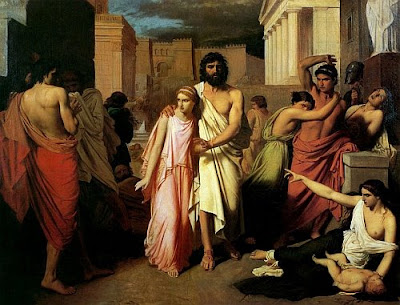
In listening to that same lecture set, Solomon mentions in passing that Oedipus's father had been the recipient of a curse. Somehow I had forgotten that. And so I thought, how foolish of me- in all of these myths, the ancestral patterns are relevant, why should Oedipus be any different?
In the old testament, it is said that the sins of the father are visited upon his children. The 10 commandments assure that disobeying souls will be punished 10 generations out. Native American traditions consider the implications for the 7th generation after them of any of their important choices. And yet we in the modern west continue to think that we just sprang out of nowhere with no ancestral antecedents or debts. (this is fundamentally an American delusion with our mythology of the immigrant surrendering all loyalty to Prince or Potentate, and presumably all inherited emotional baggage. Would that wishing made it so. . .).
So to look at the "fate" of Oedipus, with its apparent cruelty (as Solomon puts it), it would behoove us to look at the 'system,' i.e. the family of which Oedipus was but a unit, his centrality inflated by our attention to him and not his ancestors.
Did you know Oedipus's father was cursed? That he was cursed to bear a son that would slay him? Well that certainly takes some of the pressure off of Oedipus, no? After all, he might not have been such a bad guy if he were just acting out an arrangement made by his father and another actor.
In the stories, King Laius, Oedipus's father was a guest at the court of King Pelops. During his stay there, he became sexually intrigued by Pelops's son, Chrysippus, and in the night, abducted and raped him. (It's almost hard to believe this part of the story doesn't get more air time, what with our open embrace of pedophilia and homosexuality). Upon discovering the violation of his child, Pelops curses Laius that his son should murder him.
Well.
That certainly puts a different spin on things, doesn't it? Does the 'evil fate' of Laius, to be murdered by his son, seem slightly less brutal in this context? Does the guilt Oedipus experience as the agent of vengeance in another man's sensible call for justice seem somewhat overwrought? Maybe.
What is more, in the stories, both men try to avoid their fate- one out of selfishness, one out of selflessness. Laius, understanding his curse, exposes Oedipus in order to outwit fate. Oedipus, when learning of his own curse, *runs away from home* in order to spare his (adopted) father the curse of his own fate.
Would that Oedipus and Laius had had the council of Dr. von Franz. This is just the kind of ‘fate evasion’ practiced daily in psychologists’ offices as people try to outsmart their complexes through intellectual analysis. And so perhaps the ancients and their oracles were as foolish as we and our shrinks.
But to our original point. . . That the Oedipus myth is somehow central to our psyches is an arbitrary assertion. It can hardly be said that every young man born in the world is the son of a father who was cursed by a foreign king for raping his son. Furthermore, even for those fathers that did go down that path, some of them might have accepted the cosequences of their actions and raised the son anyway. Laius, however, decided to murder Oedipus, and so his son’s unconscious desire to kill his father is not some kind of ‘psychological predisposition.’ It is simply revenge.
And yet the notion persists. But perhaps we enjoy the avoidance of our fate as much as Laius and Oedipus – and all the others – did. Woody Allen, a psychological devotee, was in analysis for some 30 years before he married his daughter. So perhaps the psychological religion is destined to fail us as much as the Judeo-Christian one.
The Oedipus Complex has distorted our cultural sense of who we are by replacing the Judeo-Christian mono-myth with an equally preposterous, limited construct that simply does not apply in most cases. And still, in our search for meaning through the new religion of psychology, all manner of mythic conditions are referred back to the alleged primogenitor of complexes, the Oedipal.
Solomon, in his lectures, quotes Nietzsche as saying we shall not be through with God until we are through with language, since our notion of God is embedded in our everyday speech. Well the neuro-linguistic programmers, to say nothing of the GOP, are working on that. But in the mean time, getting rid of our notion of monotheism as the governing myth of mankind would set us well in the right direction.

In listening to that same lecture set, Solomon mentions in passing that Oedipus's father had been the recipient of a curse. Somehow I had forgotten that. And so I thought, how foolish of me- in all of these myths, the ancestral patterns are relevant, why should Oedipus be any different?
In the old testament, it is said that the sins of the father are visited upon his children. The 10 commandments assure that disobeying souls will be punished 10 generations out. Native American traditions consider the implications for the 7th generation after them of any of their important choices. And yet we in the modern west continue to think that we just sprang out of nowhere with no ancestral antecedents or debts. (this is fundamentally an American delusion with our mythology of the immigrant surrendering all loyalty to Prince or Potentate, and presumably all inherited emotional baggage. Would that wishing made it so. . .).
So to look at the "fate" of Oedipus, with its apparent cruelty (as Solomon puts it), it would behoove us to look at the 'system,' i.e. the family of which Oedipus was but a unit, his centrality inflated by our attention to him and not his ancestors.
Did you know Oedipus's father was cursed? That he was cursed to bear a son that would slay him? Well that certainly takes some of the pressure off of Oedipus, no? After all, he might not have been such a bad guy if he were just acting out an arrangement made by his father and another actor.
In the stories, King Laius, Oedipus's father was a guest at the court of King Pelops. During his stay there, he became sexually intrigued by Pelops's son, Chrysippus, and in the night, abducted and raped him. (It's almost hard to believe this part of the story doesn't get more air time, what with our open embrace of pedophilia and homosexuality). Upon discovering the violation of his child, Pelops curses Laius that his son should murder him.
Well.
That certainly puts a different spin on things, doesn't it? Does the 'evil fate' of Laius, to be murdered by his son, seem slightly less brutal in this context? Does the guilt Oedipus experience as the agent of vengeance in another man's sensible call for justice seem somewhat overwrought? Maybe.
What is more, in the stories, both men try to avoid their fate- one out of selfishness, one out of selflessness. Laius, understanding his curse, exposes Oedipus in order to outwit fate. Oedipus, when learning of his own curse, *runs away from home* in order to spare his (adopted) father the curse of his own fate.
Would that Oedipus and Laius had had the council of Dr. von Franz. This is just the kind of ‘fate evasion’ practiced daily in psychologists’ offices as people try to outsmart their complexes through intellectual analysis. And so perhaps the ancients and their oracles were as foolish as we and our shrinks.
But to our original point. . . That the Oedipus myth is somehow central to our psyches is an arbitrary assertion. It can hardly be said that every young man born in the world is the son of a father who was cursed by a foreign king for raping his son. Furthermore, even for those fathers that did go down that path, some of them might have accepted the cosequences of their actions and raised the son anyway. Laius, however, decided to murder Oedipus, and so his son’s unconscious desire to kill his father is not some kind of ‘psychological predisposition.’ It is simply revenge.
And yet the notion persists. But perhaps we enjoy the avoidance of our fate as much as Laius and Oedipus – and all the others – did. Woody Allen, a psychological devotee, was in analysis for some 30 years before he married his daughter. So perhaps the psychological religion is destined to fail us as much as the Judeo-Christian one.
The Oedipus Complex has distorted our cultural sense of who we are by replacing the Judeo-Christian mono-myth with an equally preposterous, limited construct that simply does not apply in most cases. And still, in our search for meaning through the new religion of psychology, all manner of mythic conditions are referred back to the alleged primogenitor of complexes, the Oedipal.
Solomon, in his lectures, quotes Nietzsche as saying we shall not be through with God until we are through with language, since our notion of God is embedded in our everyday speech. Well the neuro-linguistic programmers, to say nothing of the GOP, are working on that. But in the mean time, getting rid of our notion of monotheism as the governing myth of mankind would set us well in the right direction.
Unpacking Oedipus - Part II
So from my perspective, it is arguable about which (if any) of Freud's legacies has contributed most to public health, but certainly the one that has most captured the public's imagination is the famous "Oedipus Complex." And it is no wonder- modern man, particularly in America, is sorely lacking in mythic exposure, and it is just the function of imagination that is most touched on by mythic analogs such as Oedipus.
Jung, Freud's prodigal student, complained that Freud emphasized the Oedipus Myth above all others, not realizing that the entire psychic world is the interplay of different myths, stories, and legends- infinite in number, concocted by the collective human imagination through eons of experience. Myths of childhood range from Attis to Narcissus, from Hippodamia to Mirope, and well beyond . . .the Oedipus myth is but one, and yet it is the one which has stuck with us.
Last night I was listening to a recorded lecture that the late Bob Solomon and his wife, Kathleen Higgins, were giving on the life of Nietzsche. It was the lecture on the notorious "God is Dead" theme in which the lecturers decry the lack of a "foundational myth" to replace the Christian myth, which is the one Nietzsche was referring to when he spoke of God as being dead.
I was struck by the way the lecturers described this quest as the search for a "foundational" myth. They are absolutely right that that is what the culture has been searching for for some time. But the idea itself rests on a fundamental assumption whose validity I would vigorously dispute: the modern Western bias towards Monotheism.
Monotheism, historically is not the norm. It is an aberration from the great religious traditions of mankind. The pretension that there is only one god, and with it one "foundational myth," is a fence we have wrapped ourselves in so tightly these past 4000 years that it seems almost impossible to get out of it.
And yet even in our supposed monotheism we pray to different aspects of the deity for salvation- Jehovah, Yahweh, Hashem, and others described different subtle aspects of the Hebrew God. Even the Holy Trinity and the recently assumed Virgin Mother (Congratulations, Mary) are differentiated, albeit grossly, mythic aspects of the supposedly one deity. So, as so many religious people display in everyday life, we are hypocrites- even foundationally. For while we feign to believe in one god, we in fact worship many.
And yet it is monotheism that has endured even into our 21st century. Perhaps it was Freud's ambition that latched onto this fact, or perhaps it was society that latched itself onto Freud, but the supposed ubiquity of the Oedipus Complex satisfies our modern craving for a monotheistic, "foundational myth."
Particularly for the secular educated who themselves hold the hilarious pretension of being immune from religion, the psychological mono-myth of Oedipus forms a sort of Rock of Gibraltar on which to hang their psychological theories while evading the complexity, turmoil, and irreducibility that accompanies a wholly more accurate and honest version of the psyche: the polytheistic.
The mono-myth of Oedipus has usurped the thousands of other childhood mythologems that comprise the human experience just as God-the-Father has usurped the thousands of Gods and Goddesses who have woven the story of mankind since time immemorial.
It is certainly very comforting for us to have such a strong protective father, whether in the guise of an inaccessible deity, or an equally ephemeral urge to kill our father and bed our mothers. Indeed these two parallel mono-myths share primarily the fact that lay persons rarely, if ever, experience them directly. We just have to take somebody's word for it. How convenient.
On the other hand, the multi-mythic outlook is as rich as can be, and can be experienced - indeed is always experienced - viscerally, personally, and primordially- three religious attitudes that are all but forbidden in a formalized, monotheistic setting. That these experiences happen whether we identify as monotheists or not, Oedipists or not, is the cause of much disturbance to the formalized religious structure. So there should be no wonder that over the past 2000 years especially, the monists have done their damndest to stamp out any diverging mythological threads and condemn them to the realm of "hell"- either figuratively by denunciation or physically by aggravated murder.
And yet the church didn't act alone. They extinguished polytheism by representing the interests of their constituents. After all, the Christian cult, by expurgating the notion of violence and embracing the notion of lamb-like surrender, left itself extremely vulnerable to aggression. The cthonic Roman culture of violence, out of which the original Christian sects arose, became the repressed shadow of a culture based on martyrdom and self-sacrifice.
The unconscious need, therefore, for manly protection and security grew exponentially. And what could be more secure than the mono-myth? The one sure truth in which one could take refuge.
Polytheism is sloppy. How do you know which God to pray to? How do you know (psychologically) that you are living out the Persephone Myth and not the Artemis Myth? How reassuring, then, to know you're either an Oedipus or an Electra, a Jock or a Cheerleader, as it were? This kind of Judeo-Christian-Freudian reassurance was absolutely necessary for a culture that consciously rejected militarism and the mortal protection it offered. (The Christan wars of aggression in subsequent centuries would be further evidence of the repressed violent side acting autonomously, but I find the protective violence of a fixed belief system to be a more compelling study.)
When one actively engages the polytheistic "lifestyle" things start to make a lot more sense. The "grid" into which we must force ourselves in mono-culture transforms into an ocean of connectivity. For some, this ocean remains terrifying, and the risk of drowning without proper flotation equipment is real. Fortunately, disciplines such as astrology and other mytho-temporal interface studies offer a sort of "Coast Guard for the Soul" and help us navigate our mythic waters with greater assurance. Jungian Psychology, I Ching, Tarot, and good old-fashioned Animism all offer compelling maps of the ocean's depths and can even lead one back to land, should one so desire.
Judging by the Solomon lectures, it seems as if Nietzsche with his reverence for the Greeks was very much on to this. But the unwillingness to break with the monotheistic ueber-paradigm hampered him from engaging fully in the mythic on a personal level. This great wash of different possibilities of human experience he believed were only available to the ancients but were somehow lost to himself. In fact Nietzsche's obsession with the Dionysian-Apollonian split reflects this. What he meant by this was essentially a monotheistic (Apollonian) - polytheistic (Dionysian) split, which is a false one created by the unconscious monotheistic bias. (It could also be described more simply as a masculine-feminine split with Apollo being the former, Dionysos, the latter. It is no coincidence that the great patriarchal religions are monotheistic.)
After all, polytheism *includes* the God of monotheism. There is no Apollo-Dionysos split in Pagan thought. The two are brothers, but they are also brothers with Aries, Hermes, Hephaestos, and countless others born to Zeus's concubines. Add to this Athena, Demeter, Hecate, and all the rest, and you have a vast psycho-mythic framework that is wholly compatible with itself and underpins fully the stories of our lives.
And taking us into the 21st century, in the post-Matrix era, I would have to add that we may no longer be in the age of discovering our mythic substructures but actually choosing them- or at minimum realizing that the myths we experience presently are myths we have already chosen. To wake up, therefore, while still in the dream is to choose consciously- to choose joy, suffering, endurance, exhaustion or whatever story catches our fancy.
Surely nothing could be more terrifying to the fundamentalist monists out there. But the gradual loosening of the death grip on mortal security has in fact been the stated intention of the Church teachings for 2000 years. Perhaps it took two millenia of pretense to arrive at a place where we can actually do what that god demanded of us- let go of our attachment to mortal protection and flow with the ever-unfolding stories that are our lives.
My intention in this piece was to undermine a bit the particular notion of Oedipus and its centrality in modern psychology, so I would like to say a few things about that (although I confess the detour may have been much more interesting than the destination may yet be!). We'll take them up in Part III.
Jung, Freud's prodigal student, complained that Freud emphasized the Oedipus Myth above all others, not realizing that the entire psychic world is the interplay of different myths, stories, and legends- infinite in number, concocted by the collective human imagination through eons of experience. Myths of childhood range from Attis to Narcissus, from Hippodamia to Mirope, and well beyond . . .the Oedipus myth is but one, and yet it is the one which has stuck with us.
Last night I was listening to a recorded lecture that the late Bob Solomon and his wife, Kathleen Higgins, were giving on the life of Nietzsche. It was the lecture on the notorious "God is Dead" theme in which the lecturers decry the lack of a "foundational myth" to replace the Christian myth, which is the one Nietzsche was referring to when he spoke of God as being dead.
I was struck by the way the lecturers described this quest as the search for a "foundational" myth. They are absolutely right that that is what the culture has been searching for for some time. But the idea itself rests on a fundamental assumption whose validity I would vigorously dispute: the modern Western bias towards Monotheism.
Monotheism, historically is not the norm. It is an aberration from the great religious traditions of mankind. The pretension that there is only one god, and with it one "foundational myth," is a fence we have wrapped ourselves in so tightly these past 4000 years that it seems almost impossible to get out of it.
And yet even in our supposed monotheism we pray to different aspects of the deity for salvation- Jehovah, Yahweh, Hashem, and others described different subtle aspects of the Hebrew God. Even the Holy Trinity and the recently assumed Virgin Mother (Congratulations, Mary) are differentiated, albeit grossly, mythic aspects of the supposedly one deity. So, as so many religious people display in everyday life, we are hypocrites- even foundationally. For while we feign to believe in one god, we in fact worship many.
And yet it is monotheism that has endured even into our 21st century. Perhaps it was Freud's ambition that latched onto this fact, or perhaps it was society that latched itself onto Freud, but the supposed ubiquity of the Oedipus Complex satisfies our modern craving for a monotheistic, "foundational myth."
Particularly for the secular educated who themselves hold the hilarious pretension of being immune from religion, the psychological mono-myth of Oedipus forms a sort of Rock of Gibraltar on which to hang their psychological theories while evading the complexity, turmoil, and irreducibility that accompanies a wholly more accurate and honest version of the psyche: the polytheistic.
The mono-myth of Oedipus has usurped the thousands of other childhood mythologems that comprise the human experience just as God-the-Father has usurped the thousands of Gods and Goddesses who have woven the story of mankind since time immemorial.
It is certainly very comforting for us to have such a strong protective father, whether in the guise of an inaccessible deity, or an equally ephemeral urge to kill our father and bed our mothers. Indeed these two parallel mono-myths share primarily the fact that lay persons rarely, if ever, experience them directly. We just have to take somebody's word for it. How convenient.
On the other hand, the multi-mythic outlook is as rich as can be, and can be experienced - indeed is always experienced - viscerally, personally, and primordially- three religious attitudes that are all but forbidden in a formalized, monotheistic setting. That these experiences happen whether we identify as monotheists or not, Oedipists or not, is the cause of much disturbance to the formalized religious structure. So there should be no wonder that over the past 2000 years especially, the monists have done their damndest to stamp out any diverging mythological threads and condemn them to the realm of "hell"- either figuratively by denunciation or physically by aggravated murder.
And yet the church didn't act alone. They extinguished polytheism by representing the interests of their constituents. After all, the Christian cult, by expurgating the notion of violence and embracing the notion of lamb-like surrender, left itself extremely vulnerable to aggression. The cthonic Roman culture of violence, out of which the original Christian sects arose, became the repressed shadow of a culture based on martyrdom and self-sacrifice.
The unconscious need, therefore, for manly protection and security grew exponentially. And what could be more secure than the mono-myth? The one sure truth in which one could take refuge.
Polytheism is sloppy. How do you know which God to pray to? How do you know (psychologically) that you are living out the Persephone Myth and not the Artemis Myth? How reassuring, then, to know you're either an Oedipus or an Electra, a Jock or a Cheerleader, as it were? This kind of Judeo-Christian-Freudian reassurance was absolutely necessary for a culture that consciously rejected militarism and the mortal protection it offered. (The Christan wars of aggression in subsequent centuries would be further evidence of the repressed violent side acting autonomously, but I find the protective violence of a fixed belief system to be a more compelling study.)
When one actively engages the polytheistic "lifestyle" things start to make a lot more sense. The "grid" into which we must force ourselves in mono-culture transforms into an ocean of connectivity. For some, this ocean remains terrifying, and the risk of drowning without proper flotation equipment is real. Fortunately, disciplines such as astrology and other mytho-temporal interface studies offer a sort of "Coast Guard for the Soul" and help us navigate our mythic waters with greater assurance. Jungian Psychology, I Ching, Tarot, and good old-fashioned Animism all offer compelling maps of the ocean's depths and can even lead one back to land, should one so desire.
Judging by the Solomon lectures, it seems as if Nietzsche with his reverence for the Greeks was very much on to this. But the unwillingness to break with the monotheistic ueber-paradigm hampered him from engaging fully in the mythic on a personal level. This great wash of different possibilities of human experience he believed were only available to the ancients but were somehow lost to himself. In fact Nietzsche's obsession with the Dionysian-Apollonian split reflects this. What he meant by this was essentially a monotheistic (Apollonian) - polytheistic (Dionysian) split, which is a false one created by the unconscious monotheistic bias. (It could also be described more simply as a masculine-feminine split with Apollo being the former, Dionysos, the latter. It is no coincidence that the great patriarchal religions are monotheistic.)
After all, polytheism *includes* the God of monotheism. There is no Apollo-Dionysos split in Pagan thought. The two are brothers, but they are also brothers with Aries, Hermes, Hephaestos, and countless others born to Zeus's concubines. Add to this Athena, Demeter, Hecate, and all the rest, and you have a vast psycho-mythic framework that is wholly compatible with itself and underpins fully the stories of our lives.
And taking us into the 21st century, in the post-Matrix era, I would have to add that we may no longer be in the age of discovering our mythic substructures but actually choosing them- or at minimum realizing that the myths we experience presently are myths we have already chosen. To wake up, therefore, while still in the dream is to choose consciously- to choose joy, suffering, endurance, exhaustion or whatever story catches our fancy.
Surely nothing could be more terrifying to the fundamentalist monists out there. But the gradual loosening of the death grip on mortal security has in fact been the stated intention of the Church teachings for 2000 years. Perhaps it took two millenia of pretense to arrive at a place where we can actually do what that god demanded of us- let go of our attachment to mortal protection and flow with the ever-unfolding stories that are our lives.
My intention in this piece was to undermine a bit the particular notion of Oedipus and its centrality in modern psychology, so I would like to say a few things about that (although I confess the detour may have been much more interesting than the destination may yet be!). We'll take them up in Part III.
Unpacking Oedipus - Part I
I go in and out with Freud, if you’ll excuse me. I write him off as a product of his time and heritage, I see him as a revisionist career-monger, I admire him as a genius, and yet I see him as a curse on our time.

The widespread dispensation of psychology has been one of the great plagues on modern society. Underestimating the psyche’s genius for maintaining its protective perversions, psychological knowledge in the public’s hands has served little purpose but to give the psyche one more line of defense- to believe itself ‘cured’ through alignment with academic insights. And yet we are the worse for it, since the human believes its psyche to be cured, where instead its neurosis has only hidden itself farther from view.
I have no doubt that the first generation of psychiatric patients under Freud’s care experienced miraculous recoveries. The healings arose spontaneously from the psyches of those seeking cure. They were not attempting to match up their unfolding with a textbook description of some generic healing process. They were authentic.
But modern psychological healings are over-contaminated by patients' presuppositions about psychological complexes and "defense mechanisms." This complicates the matter infinitely.
To draw an analogy, we can look at the evolution of musical compositional technique in the western world. First there was the music. The composers who innovated and developed the language, from Monteverdi to Bach, from Beethoven to Schumann, did so out of their own imaginative psyches. Their music was authentic.
Then, following their developments the discoveries were codified, mass-disseminated, and became fixed canons of musical technique. The result was a kind of ‘plug and play’ compositional style in which the forms conscientiously imitated those of the masters, presumably in order to get good marks in the music conservatory-factories of the 19th century (particularly in France). You have probably never heard these pieces, since their ability to stand the test of time was nonexistent. They were not “cured” the way the originals were. They became exercises in imitation and people-pleasing rather than creative revelations from deep beyond.
We moderns do the same thing with our psychology. We understand the forms- repression, projection, and the Oedipal Drama, and we plug our lives and experiences into them. And the result is just the same as with the French conservatory composers- a dull shade of a life, an unremarkable journey.
Because it is not the forms that cure, it is the process- the organic unfolding that defies prediction, regularity, or reliability. “Psyche” both in myth and fact is feminine, and she flows and changes and has no desire to be pinned down. She has her own rhythm, her own destiny process. This process is usually unknown even to herself- and it is certainly unknown to you and your books.
Marie-Louise von Franz is one of those rare psychologists (herself in the Jungian tradition) who understood the destructive quality that psychology had on modern life, particularly on the young. She went so far as to say that it would be better to grow up in an unconscious, neurotic household than one which had learned to ‘tame’ their neuroses with the morality of psychology, yet which still remained neurotic underneath. This situation gives the developing child the doubly hard task of discerning what was farcical overlay and what was foundational in terms of their own psychological troubles.
For von Franz, the process was receptive, as would befit Psyche herself. In “The Cat,” she describes an analysis she had with a young man who came to see her with a stock set of problems. She knew what the problem was and what the solution would be, and yet when the man told her his dreams, it didn’t add up. The dreams led in a completely different direction. It was von Franz’s genius (and courage) to place her diagnoses on the shelf and follow the dreams instead, which led, eventually, to the self-same conclusion she had drawn in the first place. And yet it was clear that in order for the patient to realize that conclusion in a useful, cathartic way, Psyche had to dream her own journey, her own unraveling, perhaps retracing the steps the neurosis took in forming- which were, in any case – in every case – unique to the patient.

This is masterful analysis, and really requires far less analysis than the other version, the young shrink eager to prove his “theories” and “cure” the patient. As happens often enough (see “Lying on the Couch” by I. Yalom for a brilliant satire) the patient will conform his psychic healing to the expectation of the therapist, just as French conservatory students would compose in order to get their “prix” from the designated authority figure at the Conservatoire.
Certainly there are therapists trained to deal with this version of ‘counter transference,’ but Psyche is usually cleverer than they. After all, if you are subject to desiring this kind of professional vindication, simply “knowing about it” won’t make any difference to your psyche. Just as the patient pretending to be cured, your own psyche will pretend to be objective. And in both cases one is swindled by one’s own mind.
As with the patient, the analyst must have the degree of certainty possessed by the likes of von Franz to relinquish control of the process in order to allow it to unfold as it desires. Holding such a healing environment for the patient may be the one guarantor of success, and yet the manner of that success will be entirely without precedent. How magical indeed. And yet it’s just another day for Psyche.
The widespread dispensation of psychology has been one of the great plagues on modern society. Underestimating the psyche’s genius for maintaining its protective perversions, psychological knowledge in the public’s hands has served little purpose but to give the psyche one more line of defense- to believe itself ‘cured’ through alignment with academic insights. And yet we are the worse for it, since the human believes its psyche to be cured, where instead its neurosis has only hidden itself farther from view.
I have no doubt that the first generation of psychiatric patients under Freud’s care experienced miraculous recoveries. The healings arose spontaneously from the psyches of those seeking cure. They were not attempting to match up their unfolding with a textbook description of some generic healing process. They were authentic.
But modern psychological healings are over-contaminated by patients' presuppositions about psychological complexes and "defense mechanisms." This complicates the matter infinitely.
To draw an analogy, we can look at the evolution of musical compositional technique in the western world. First there was the music. The composers who innovated and developed the language, from Monteverdi to Bach, from Beethoven to Schumann, did so out of their own imaginative psyches. Their music was authentic.
Then, following their developments the discoveries were codified, mass-disseminated, and became fixed canons of musical technique. The result was a kind of ‘plug and play’ compositional style in which the forms conscientiously imitated those of the masters, presumably in order to get good marks in the music conservatory-factories of the 19th century (particularly in France). You have probably never heard these pieces, since their ability to stand the test of time was nonexistent. They were not “cured” the way the originals were. They became exercises in imitation and people-pleasing rather than creative revelations from deep beyond.
We moderns do the same thing with our psychology. We understand the forms- repression, projection, and the Oedipal Drama, and we plug our lives and experiences into them. And the result is just the same as with the French conservatory composers- a dull shade of a life, an unremarkable journey.
Because it is not the forms that cure, it is the process- the organic unfolding that defies prediction, regularity, or reliability. “Psyche” both in myth and fact is feminine, and she flows and changes and has no desire to be pinned down. She has her own rhythm, her own destiny process. This process is usually unknown even to herself- and it is certainly unknown to you and your books.
Marie-Louise von Franz is one of those rare psychologists (herself in the Jungian tradition) who understood the destructive quality that psychology had on modern life, particularly on the young. She went so far as to say that it would be better to grow up in an unconscious, neurotic household than one which had learned to ‘tame’ their neuroses with the morality of psychology, yet which still remained neurotic underneath. This situation gives the developing child the doubly hard task of discerning what was farcical overlay and what was foundational in terms of their own psychological troubles.
For von Franz, the process was receptive, as would befit Psyche herself. In “The Cat,” she describes an analysis she had with a young man who came to see her with a stock set of problems. She knew what the problem was and what the solution would be, and yet when the man told her his dreams, it didn’t add up. The dreams led in a completely different direction. It was von Franz’s genius (and courage) to place her diagnoses on the shelf and follow the dreams instead, which led, eventually, to the self-same conclusion she had drawn in the first place. And yet it was clear that in order for the patient to realize that conclusion in a useful, cathartic way, Psyche had to dream her own journey, her own unraveling, perhaps retracing the steps the neurosis took in forming- which were, in any case – in every case – unique to the patient.
This is masterful analysis, and really requires far less analysis than the other version, the young shrink eager to prove his “theories” and “cure” the patient. As happens often enough (see “Lying on the Couch” by I. Yalom for a brilliant satire) the patient will conform his psychic healing to the expectation of the therapist, just as French conservatory students would compose in order to get their “prix” from the designated authority figure at the Conservatoire.
Certainly there are therapists trained to deal with this version of ‘counter transference,’ but Psyche is usually cleverer than they. After all, if you are subject to desiring this kind of professional vindication, simply “knowing about it” won’t make any difference to your psyche. Just as the patient pretending to be cured, your own psyche will pretend to be objective. And in both cases one is swindled by one’s own mind.
As with the patient, the analyst must have the degree of certainty possessed by the likes of von Franz to relinquish control of the process in order to allow it to unfold as it desires. Holding such a healing environment for the patient may be the one guarantor of success, and yet the manner of that success will be entirely without precedent. How magical indeed. And yet it’s just another day for Psyche.
Wednesday, January 14, 2009
SATANS

The Society for the Abolition of the 18th St. Subway Station
Need I say more? I needn't, but superfluousness being the theme of the day, I shall.
You're drunk. It's nearing midnight at the 14th St. stop and you're headed to 72. You're waiting in that uncertain cusp on the IRT when you don't know if the express trains are still running. You wait a full 9 minutes hoping the 3 will come charging down the left lane. But no, gently the 1 train ambles up to the local track and you make your calculations.
"Is it worth getting on and maybe missing the express?"
"I could always change at 42nd."
"No dog gone it, I'm going to wait."
15 minutes go by. Nothing. By 10 minutes you already know you've made the wrong bet, and when another 1 lumbers in on the local track, you reluctantly enter and cut your losses.
As the local train dribbles out of the station at well below its cruise speed, you attempt to salvage the situation. "Maybe the 2 will show up just as we pull in to Times Square, and I can at least claim to break even. . ."
But just as your enthusiasm mounts and only moments after leaving the 14th St. station the conductor suddenly slams on the brakes. What is it? A track fire? An electrical outing? A flood maybe?
No. It's the 18th St. Subway Station.
Nobody gets on. The doors sit open for the requisite 15 seconds, rubbing the salt in to your self-recriminations, and then the train surges forward- again well below cruise.
Now you're sick to your stomach. "How could I have let that first train go? I'd already waited 10 minutes. I would have been home by now. . ." But then suddenly the train comes screeching to a halt. 23rd St.
"Oy," you think. "Should've taken a cab."

The preceding story is only a slight dramatization of a situation that befalls New Yorkers hundreds of times each day. Why, oh why must we stop at the 18th St. Subway Station?
When I was young, people took the bus. They took the bus to go to the 'in between' blocks, the non-crosstown blocks. Even the fattest, unhealthiest old lady could get off the bus and be not more than 2 blocks from her desired cross St. The subway was intended for the hardier and for those who were in a hurry to cover longer distances.
Subway stations were generally spaced so that at most each station would be no farther than 8 or 10 blocks apart, meaning no one would have to walk more than 4 or 5 blocks in either direction to catch their train. If need arose, they could always take the bus for those in between blocks.
But this sensible partitioning of our public transport breaks down in Chelsea. For the mile stretch between Waverly and 30th St. you are never more than 2 blocks from a train station.
The contention of SA18SSS is that if you can't walk more than 2 blocks to get to the train, then you probably can't make it up and down the stairs to get you to the station, and you should probably do what everybody else in that situation does: take the bus.
Not that I don't have sympathy with some of the Chelseaites who adore their own special slice of underground real estate. My dear friend Max is heir to a loft right on 18th between 6th and 7th that in my youth I frequented frequently. I would get off at 18th street in the dead of winter and not even bother putting on my scarf since I would be inside within moments. What a pleasure.
But I can not justify this profligacy in any real sense when I think of the economic implications for the city- to say nothing of the spite visited upon 18th St. exiters by those forced to accommodate their convenience.
No.
I estimate that each forced stop at the 18th St. subway station adds between 45 and 120 seconds to each subway ride (including slower travel speed, passenger exchange, and the occasional holding open of doors). Multiply this by the number of passengers on the train and multiply that by the number of trains running up and down the IRT every day. Now multiply that by 365 and you'll get the number of lost man-hours of work (and lost shopping hours on the weekends), and you'll realize that the 18th St. subway station is simply a luxury we can't afford.
I know there will be protests from the folks who live nearby and from that crappy falafel place on 19th st whose only business must come from those in transit to the 18th St. stop. But New Yorkers are a sturdy breed, and we've been through a lot together. Surely this is one more hardship we can endure for the greater good.
So I say: the time for action is now. Join us at SATANS (maybe an easier acronym) and keep the tracks of New York well lubed for the challenges ahead.
SATANS - it's a *hell* of an idea.
Wednesday, July 23, 2008
Solo Percussion, Alternative Medicine, and, oh, Motivational Speaking

When I was a percussionist, way back when, it was basically understood that a solo career - in the mold of violin or piano virtuosi - was more or less out of the question. Not that there weren't any virtuostic percussionists in those days - there most certainly were. What was lacking was repertoire. There were no Brahms marimba concerti nor Beethoven sinfonia concertante for glockenspiel, side drum, and maracas. Just wasn't part of the old culture. The few bits of listenable modern music written for solo percussion were intriguing, but they were in heavy competition with all the bits of listenable modern music written for tuba, saxophone, viola, and english horn. Add this to the stigma of playing (or banging on, as we were often accused of doing) percussion instruments in general, and most of us turned our ambitions elsewhere.
But there was one notable exception: Evelyn Glennie, the Scottish virtuoso percussion soloist. She had a career.
One doesn't have to be too cynical to believe that marketing a percussion soloist requires having a few tricks up your sleeve to really get you off the ground, and Glennie had two.
Number one, she was a chick (and not a bad looking one at that). Number two - and this is the kicker - she was deaf. Deaf? Deaf. As a doornail? Not exactly, but deaf enough that her deafness could be a point of conversation engrossing enough to get you through the intermission without having to discuss how vapid and banal the actual music was.
In case you yourself are engrossed at this time, I can elaborate from the little bit I know about her status: the gal was legally deaf and allegedly was able to play in sync with the orchestras by 'feeling the vibration through the floor with her feet.' Well you can imagine how you'd get a whole intermission's worth of chit-chat out of that one, no?
Interesting. But as someone who was keenly aware of the stigma associated with being a percussionist in general (that one was responsible primarily for making loud, unpleasant noises), I couldn't help but bemoan that our leading celebrity, the de facto spokesperson for our cause, was actually deaf. You never heard of deaf violinists or deaf pianists (though some blind ones perhaps)- presumably because it required some degree of artistic refinement to play these instruments. But a deaf drummer. . . (snicker) it kinda makes sense. I knew I would not last in that world for long.
But recently I got a flashback of my childhood distraughtness (word?) while listening to the headlines about former Serbian fugitive Radovan Karadzic, the mass-murderer turned swami who was recently arrested after 13 years in hiding. Karadzic, the former Bosnian Serb president, is alleged to be responsible for the massacre of some 8,000 Bosnian men and boys at Srebrenica and has been in hiding since his indictment for the crime in 1995.
That he was able to live out in the open as a practitioner and lecturer on what the press is calling "alternative medicine" is a Glennie-like blow to the integrity of the field. Now, what alternative medicine means in Serbia is anyone's guess, so perhaps we need not be too concerned at the defamation of our already struggling practice (those of us who are engaged in the alternative medicine field). But I can't help but be saddened that he did not pursue the field of orthodox medicine - in which he could have legally continued his killing spree and been highly compensated for it indeed! Or perhaps a quiet accountant or a piano technician- professions of honor and distinction in European society. But no, he joined the ranks of the swindlers and snake oil peddlers, grew an enormous beard that would shame any Chakrapani, Ramakrishnan, or Shivananda, and preached health to the masses. Unbelievable.
Anyway. . .I may be making more of this than there is, and in fact I almost certainly am. But nonetheless I find the parallels and the emerging pattern worthy of further investigation- if for no other reason than to examine my own quirky and eccentric career choices.
Below is a recording. . .
Wait. You won't believe this, but as I went searching for a sound byte recording of Evelyn Glennie's to leave you with, I discovered a link to her website:
Dame Evelyn Glennie: Motivational Speaker, Media Composer, and Jewelery Designer. Perhaps she'll start teaching Reiki soon as well. . .
Saturday, February 23, 2008
Plug

I saw this woman's art work at the Santa Cruz Bookshop last year. Really liked it. This is from her '08 calendar.
Check out nikkimcclure.com
Not everything speaks to me as loudly as everything else, but I enjoy her particularly pacific style very much
D
Thursday, February 21, 2008
How to Brush - a follow up
So it turns out that when you have a blog, you can post any old thing you want to, any old time you want to. How cool is that?
So this is lifted from glenbrooksfarm.com, but it's mainly an elaboration on a plan I've been having since my last trip to the dentist.
My last dentist trip took two trips. The first one he checked to see if my fillings were loose, as I was in a little bit of pain. They weren't.
So I came back the next day to meet with his crony who had a new age-y way of checking your teeth involving applied kinesiology and some sort of dentalized cranio-sarcal work. This guy assured me that my fillings weren't loose since, in his words, dentist make good money by replacing fillings, so if one of them was loose he would have found it. Finally, an honest doctor.
This guy had me chewing on all kinds of dental chew paper which left little purple dyes on my teeth to show where they were rubbing together. Fascinating. He offered to drill down my teeth where the markings were, then even them out side to side. Or he could put little shims on either side of my mouth to stack me up above the problem. Neither solution interested me, so I left.
What he didn't do was take the purple dye off, so whatever was on that stuff stayed on my teeth through the night.
Well the short version is for the next three days my teeth hurt twice as much as they had the preceding month. Seriously hurt. It strains even my conspiratorial instincts to believe that the ADA would put some kind of acid on their dental strips to punish patients that don't allow their teeth to be drilled down, but really, what other explanation is there?
Anyway, highly pissed, I determined to scrub whatever residue was left off of my teeth with good ol' fashioned baking soda, just like the pilgrims did- or whoever.
Well sure enough it worked. Not only was the extra post-dentist pain gone, but the original pain is gone to, and I can chew without issue. But just to rub it in, I ordered some powdered (non-irradiated) bentonite from the online herb people and mixed it in with the baking soda. Bentonite clay sucks all of the toxins out of anything, so if there were, as they claim, bacteria hanging out in my gums, this stuff would pick it up and wash it away. Awesome.
Below is an elaboration on my recipe. Use in good health.
D
Btw- just read through the recipe- please store in a GLASS jar. You don't want the bentonite wasting its sucking power on the toxins in your plastic cup from Wal-Mart. Also, it's not totally necessary to wet the toothbrush. You can just dip it in the jar or sprinkle it on top if you're sharing and are worried about germs. D
1/2 cup Baking Soda
1/2 cup bentonite clay powder
11/2 teaspoon Myrrh powder
1 teaspoon dried Raspberry leaf
1 teaspoon dried white oak bark powder
1 teaspoon flavoring herbs of your choice (Fennel
Peppermint, Spearmint, in powder form)
5 drops Essential Oil of Tea Tree
Yield: about 1 cup
Pour the Baking Soda (soda reduces the acid level in the mouth. High acid creates tooth decay) and Bentonite clay powder into a medium-size mixing bowl. Add all the dry ingredients, including the Myrrh powder,( which helps to prevent periodontal disease) to the Baking Soda/Clay mixture. Mix well with a wire whisk. Add the Tea Tree oil, again mixing well. Place a clean cover over the bowl, covering it completely. Let sit overnight. The next morning, mix well again . Package in an wide-mouthed jar. It will last indefinitely if you keep moisture out of the package.
To use: Wet your toothbrush, then sprinkle a small quantity of toothpaste powder onto your brush. Brush thoroughly and gently in an up and down motion. Rinse, Feel the natural clean!
So this is lifted from glenbrooksfarm.com, but it's mainly an elaboration on a plan I've been having since my last trip to the dentist.
My last dentist trip took two trips. The first one he checked to see if my fillings were loose, as I was in a little bit of pain. They weren't.
So I came back the next day to meet with his crony who had a new age-y way of checking your teeth involving applied kinesiology and some sort of dentalized cranio-sarcal work. This guy assured me that my fillings weren't loose since, in his words, dentist make good money by replacing fillings, so if one of them was loose he would have found it. Finally, an honest doctor.
This guy had me chewing on all kinds of dental chew paper which left little purple dyes on my teeth to show where they were rubbing together. Fascinating. He offered to drill down my teeth where the markings were, then even them out side to side. Or he could put little shims on either side of my mouth to stack me up above the problem. Neither solution interested me, so I left.
What he didn't do was take the purple dye off, so whatever was on that stuff stayed on my teeth through the night.
Well the short version is for the next three days my teeth hurt twice as much as they had the preceding month. Seriously hurt. It strains even my conspiratorial instincts to believe that the ADA would put some kind of acid on their dental strips to punish patients that don't allow their teeth to be drilled down, but really, what other explanation is there?
Anyway, highly pissed, I determined to scrub whatever residue was left off of my teeth with good ol' fashioned baking soda, just like the pilgrims did- or whoever.
Well sure enough it worked. Not only was the extra post-dentist pain gone, but the original pain is gone to, and I can chew without issue. But just to rub it in, I ordered some powdered (non-irradiated) bentonite from the online herb people and mixed it in with the baking soda. Bentonite clay sucks all of the toxins out of anything, so if there were, as they claim, bacteria hanging out in my gums, this stuff would pick it up and wash it away. Awesome.
Below is an elaboration on my recipe. Use in good health.
D
Btw- just read through the recipe- please store in a GLASS jar. You don't want the bentonite wasting its sucking power on the toxins in your plastic cup from Wal-Mart. Also, it's not totally necessary to wet the toothbrush. You can just dip it in the jar or sprinkle it on top if you're sharing and are worried about germs. D
1/2 cup Baking Soda
1/2 cup bentonite clay powder
11/2 teaspoon Myrrh powder
1 teaspoon dried Raspberry leaf
1 teaspoon dried white oak bark powder
1 teaspoon flavoring herbs of your choice (Fennel
Peppermint, Spearmint, in powder form)
5 drops Essential Oil of Tea Tree
Yield: about 1 cup
Pour the Baking Soda (soda reduces the acid level in the mouth. High acid creates tooth decay) and Bentonite clay powder into a medium-size mixing bowl. Add all the dry ingredients, including the Myrrh powder,( which helps to prevent periodontal disease) to the Baking Soda/Clay mixture. Mix well with a wire whisk. Add the Tea Tree oil, again mixing well. Place a clean cover over the bowl, covering it completely. Let sit overnight. The next morning, mix well again . Package in an wide-mouthed jar. It will last indefinitely if you keep moisture out of the package.
To use: Wet your toothbrush, then sprinkle a small quantity of toothpaste powder onto your brush. Brush thoroughly and gently in an up and down motion. Rinse, Feel the natural clean!
Saturday, November 10, 2007
From Deeeep in the Archives
I think this is from about 2000. Haven't re-read it all, but I remember writing it in an effort to summarize my musical convictions at the time before what I felt might be a major change in world outlook. So here it is. . .the "Vide" section in the middle was a nod to Bruckner who used the word (Vi - de) to indicate material that could/should be cut if it came off as too much. You can take it in that same vein.
D
When people ask me what I do, I usually have to explain:
“I’m a musician.”
“Wow, really? What kind of music do you play?”
“Classical.”
“Oh.”
And here things get a bit funny. This “Oh.” is filled with a sort of learned, that is, conditioned, reverence. The sort of reverence one has for something of which one has little understanding or experience but of which one “knows” to be of a higher order- way higher than one’s own present ignorance and shame could relate. I think the feeling must be similar to a lay person on the street who mid-conversation finds that he is talking to a Rabbi. “Oh.” There is the strange sense that the lay person must either repent or shamefully admit his ignorance of the higher truths of Judaism and, if Jewish, his sparse attendance at Synagogue.
This is a problem. Religion, in recent centuries, has moved farther and farther away from what could be called direct religious experience. By this I mean a meaningful personal encounter with the divine or numinous forces of the universe. These experiences have been replaced by a sort of ‘book-learning’ of Religion, which parallels the track of most of our ‘academic’ disciplines. Reading through the complete works of Shakespeare does not make one Shakespeare or give one the experience of channeling those works. It does not even make one an actor with the experience of the words and their meaning flowing through one in mid-performance as if from a source outside oneself. This is the essence of acting, and it is also the essence of Religion. Unfortunately, we have become so disconnected from this Religious heritage that for the modern atheist, such an experience is deemed schizophrenic, and for the modern believer, simply heretical.
So for most of us, to cling to the written word and the prescribed teachings is a pretty safe bet- and safe it is indeed. Organized Religion was once described to me as very similar to the process of immunization. You get tiny little dead bits of something which serve to prevent you from getting the real thing. Clever. However, behind all this is a very strange social phenomenon for the contemporary ‘educated’ urbanite: When someone approaches him bearing the badge of Religion, he still steps back with some uncertainty, even though he really doesn’t believe any of that nonsense, and would rather read Darwin or listen to U2. I have the sense, though, that he still, beneath it all, has some feeling that there’s something numinous back there, but he is very intimidated because he is receiving the impression that it’s ‘up’ there and that he is not worthy.
Needless-to-say, there are those of the cloth and of the baton who have rather enjoyed this awe and used it to their best advantage. The ‘Maestro Myth’ as it has been called is well known, as is the maniacal preacher. The same inflation is even evident in the pomposity of the fin de ciecle Austrian in his traditional garb. Yet, for most of us, since the war, and definitely since the 60’s, this inflation has lost some of its hot air, that is, steam. In other words, we no longer buy it. We no longer buy the hell and brimstone and eternal damnation, and we no longer buy the tuxedos and the heavy German accents, and we no longer buy the ‘fiery’ Beethoven. How can he compare, after all, to the noise of a Boeing 747 or Jimi Hendrix at Woodstock. Are we to be impressed by a well placed Augmented 6th Chord as we are led to believe they were ‘back in the day?’ It’s not possible. Yet we still have the diluted forms, the symbols- The Maestros and the fur coats hinting at a certain magnificence which they now fail to deliver. It is what Alan Watts calls ‘confusing the Menu with the Meal.’ You do not eat the menu and you do not experience the transcendentalism of Wagner in a tuxedo (and, no, not even in one of those Viking Helmets). There is a ‘realistic’ and ‘sensible’ public now, especially the young (about whom and in vain so many funds have been raised) who is not sold on the smoke and mirrors of the classical music ethos- which, in all honesty, he finds completely revolting.
And then there’s this estranged reverence. And at the heart of this is distance. “Oh.” That word drives a 4000 mile and 150 year wedge between us. It separates the listener from the performer. What could be worse? When I was young, every girl who could get near her dad’s credit card dressed like Madonna. Now it’s Brittany Spears. These kids identify full-on with their performers and their music. How can you argue with that? A rock concert is a trance-endental experience, full of contemporary, immediate meaningfulness that is impossible to deny- whether you like it or not. Now one could say that in the absence of an Olympic Pantheon, or even a beginning relationship with the unconscious, these kids are projecting enormous archetypal powers onto the superstars, and they (the superstar) are in a sense fulfilling a deep religious longing in the population. I feel this is quite true, and one experiences it even as a ‘classical’ musician. Then again, is this so wrong? Yes it is in a rather primitive and contaminated form, but haven’t music and religion always been welcome bedfellows? No religion has ever got along without music to vamp up the religious emotion, and every truly great musical experience has a palpable religious tinge to it. I think mostly of the early shamanic ‘religions’ where drumming and dance were the very sacraments of the culture and that contemporary dances, from the Froog to the Makarena to whatever, are our modern, secular equivalents. And they are secular only in that the religious aspect is consciously (via the superego) denied, and the religious experience (through the schools and the churches- on the same side in this one) is completely denigrated.
So back to music itself- and I mean now older music. “Classical Music.”
Usually when someone asks, “Wow, really? What kind?” I answer, “Classical- but it’s not lame.” That is followed by a relieved, acknowledging chuckle, the equivalent of, “I’m a priest, but you’re not going to hell.” Everybody knows it. Classical music is lame. And they’re right. Because beyond the average public’s so-called ignorance (yet it is very wise!), there is the equal ignorance of the classical musicians themselves as well as the so-called concert-going “music-lovers.” Here’s the secret: Nobody knows what the hell is going on. That’s why they hide behind tuxedos, snootiness, and champagne.
The musicians themselves, the priests, the oracles, the mediums of the Music have no numinous relationship with the music AT ALL. The concert-goers, in an attempt not to be/appear obtuse (remember the awkward reverence), always fake it. And I mean always. The concert-goer who asks, “Oh wasn’t that delightful (or lovely or beautiful or ‘lyrical’)?” is still asking. They aren’t standing on any kind of firm ground. How many times does one hear at intermission, “That was the best (or worst) performance of X piece ever. Here’s why: The phrasing was so and so, except in the recapitulation where they did it so and so. The dynamics were clear so that the usually obscured second flute solo was not covered by the bass trombone, etc. The conductor’s rhythmic sensibility helped to delineate the structure and the rhetoric of the piece, etc. etc.” When? Never, and it’s because nobody knows. Once again, don’t feel too badly- the players don’t know it either. So guess what: The bass trombone will always obscure the second flute solo, the phrasing will never be so and so (nobody phrases, period- so how would you even know what that means?), and the conductor will never delineate anything. What does a conductor do anyway? Ask a musician. They won’t know. Ask a conductor. They won’t know either. Listen hard- you’ll never get a straight answer about classical music performance from anybody. At best you’ll get lofty generalizations about ‘romanticism,’ ‘formalism,’ ‘dissonance’ or other intangibles- used to feign sophistication. In the words of the great pianist, Leonid Hambro, “It’s a lotta bullshit.”
-Vide-
But what more can you expect? Your average symphony concert gets between 1 and 4 rehearsals. So for two hours of music, you will be lucky to get eight to ten hours of rehearsal- enough to play the piece through a few times, make sure everybody remembers to take the repeat in the fourth movement and that the second movement will be in 16. That’s about it. What about phrasing? (Still nobody knows what it is- does it make a difference? Is it worth it? Will anybody notice? Still no one can answer these questions because they don’t know how to phrase. They don’t know how to listen- and I mean performers, not just the public). What about variety of sound? Of rhythm? Of articulation? Of dynamic? Has the conductor studied the score enough to have a conception of the piece (not just to imitate recordings of other conductors who have never studied the score themselves)? Does he know what to look for or how to study? Then when he has a vision (and this is VERY rare), can he communicate it to the orchestra? Then once he communicates it, does he get it? Does he check?
This is why most conductors now prefer to have only two or three rehearsals, because they can always bow out and say, we only have just enough time to run it through and hope for the best.
It takes about three months to really learn a complicated symphony and then mark a set of parts with adequate bowings, cues, rehearsal figures, phrasing indications, retuschen (look it up), and other necessary markings to convey the interpretation one has already learned. It is hard work. No joke. There are jokes about conductors who run through a piece three times and then talk about the beautiful sunset painted by the French Horn in the last movement. Then they play it again and that’ s it. No joke.
One basic factor that is often overlooked if the vibrato. This is something to which anyone can relate. We all saw bugs bunny cartoons as kids and watched their caricatures of opera singers with flabby, wobbly voices. Caricatures, I say, until you realize that it is quite real. They sound like horny chickens and their expression carries about the same weight. It is common ‘wisdom’ these days that this vibrato beautifies the tone and should therefore be used as often as possible- that is always. Do you know the sound to which I am referring? Make fun of an opera singer and your voice will do it automatically.
Now this vibrato is an expressive device, and you can imagine, in ordinary life that if you felt great emotion over something your voice would start to shake. This is the emotional effect that vibrating (it used to be called ‘shaking’) has on a listener. So when you are singing, “My son is dying, oh saddest day!” then you could perhaps expect some vibrato as a natural emotional ‘juicer.’ However, when you are singing, “Please pass the salt!” then such emotional extravagance would be entirely inappropriate (depending, of course, on where you’re eating). Contrary to contemporary sentimentality, not every word of an opera nor every instrumental note of a symphony is the end all –be all of the universe. Many, in fact, most are basically neutral and more or less benign. Therefore the continuous shaking which one sees in the left hands of virtually every string player is almost entirely superfluous.
What I am trying to demonstrate is that the audacious pomposity which so many of us associate with classical music (I remember French class in the 4th grade going around the classroom and saying, “J’adore le rock. Je deteste la musique classique.) has a direct technical root, and the stuffiness and flabbiness can easily be reduced by a little bit of clarity in performance (of course this must be rehearsed!). By the way, groups such as Anonymous 4, the Kings Singers, and the innumerable ‘period’ groups which have popped up in recent years owe an enormous amount of their popularity to the fact that they sing with virtually no vibrato- a pleasant foil to the over-done mutton we hear from the Big Five orchestras. There is an undeniable beauty in a basic transparency of the tone which allows the performers to channel all of the subtleties of the music. The continuous vibrato is a major hindrance to this. In discussing this with numerous classical musicians, I have had vivid flashbacks to Clarence Darrow and the Scopes Monkey trial. Fundamentalists are fundamentalists pretty much across the board.
Another surprising fact is that performers play virtually everything at the wrong tempo, that is, speed. Ok, ok- how can you say something is ‘wrong’ or ‘right’ in art? It’s supposed to be subjective, right? Well, yes and no. Since most of the musical choices people make are default non-choices based on the unconscious conditioning they have received from endless repetitions of the same recordings- whose performers themselves have made their same passive non-musical-choices from the unconscious conditioning of endless repetitions of endless repetitions of endless repetitions of endless repetitions of—Scratch! In other words, most of the subjective stuff isn’t coming from conscious choice, it’s just kind of there. Hang out at a quartet rehearsal some day (or watch the Guarneri quartet’s movie ‘High Fidelity’) to see how little active decision making goes into a contemporary musical “interpretation.”
So tempos: generally they’re too slow and they’re always the same. Ben Zander has made an excellent presentation of problems with contemporary tempo issues in Beethoven’s 5th symphony. Beethoven clearly marks one tempo and most performers brazenly perform the piece much, much slower. The effect of this is to produce a sort of stogginess in the performance which gives it a sort of blown-up, epic, titanic feel to it which sort of impresses the listener and gives him that feeling of unrelated reverence of which I have spoken earlier. Wow, that’s ‘profound’ he might say since the slowness and massiveness of the motion makes it seem awfully grave and important. Yet, it doesn’t sound like anything to him. One note does not connect to another, and he finds himself in an undifferentiated wash of sound- for 2 hours! What’s worse is that we have no other model for people to compare this with, a model that is clear and articulate and communicates a musical statement that is understandable, relatable, and not larger than life- but rather is life-sized and relevant- generating an immediate experience. This is critically important. The implication of the too-slow, amorphous approach to classical music is that this is so sophisticated that you can never understand it. As the kids my age say, “What the fuck?” What kind of self hating masochist would allow himself to be berated by an imposing ensemble of 100-odd people telling him that he is an ignorant fool? What the fuck?
Now in regards to tempo, let me say something extra about the so-called “slow movement.” There is another bit of common wisdom that expects people to fall asleep during the ‘slow’ movement. They’re boring and everyone knows it, so let’s get through it and back to the fast (but still not quite fast enough) stuff. This is ridiculous. With all the reverence we give the great masters do we really think they were that lame as to write a deliberately boring movement? Would they hope that people would doze off 10 minutes into their piece? Why write it at all? Another thing that has always interested me is that if you look on the back of your CD of some Mozart symphony, you see that the first and last movement are about 5 minutes long, the Menuetto is about 2 minutes long, and the Andante is about 18 minutes long. How is that possible? In the 18th century when formalistic balance was at its peak (I don’t really believe this, but I will certainly concede that a sense of balance was in the air) that someone –and Mozart of all people- could write a symphony so lop-sided as that? Basically, we have to realize that most performers play Andantes, Adagios, Largos, and Lentos, four to eight times slower than they were intended! Really, I mean it. Take your favorite piece of music, say Eine Kleine Nachtmusik- the first part that everybody knows. Sing it through and dance around a bit. Now sing the same thing twice as slow. Then twice as slow as that, then twice as slow as that. Now see if you can get through the whole movement without slitting your wrists or. . .dozing off.
Now you can do the opposite. Take the ‘slow’ movement of your favorite Mozart Symphony, say the Haffner, No. 35, as you heard it on your von Karajan (or worse still, Eugene Ormandy) recording. Now speed it up until you start to feel a ‘beat’ or a connection between the measures that’s not just note after note after note. To do this, however, you will have to change your conception a little bit. What I mean by that is, the way you’re probably used to hearing this, it may sound as if Mozart is trying to reveal the secrets of the universe unto you and that there is something really heavy in this piece (although you don’t know quite what it is). When you speed it up, you’ll have to put a little spring in your step. Make the notes a bit shorter and even swing them a bit (this was actually standard performance practice even as late as the 1930s. It is called noes inegales, or unequal notes, which gave a certain lilt to performances very similar to 20th century jazz performance {which not un-coincidentally began around 1930). Dance around the room a bit as you sing and start to feel the gist of the music. Or you can walk around the room and sing in time with your feet. Andante, which is what the movement is marked, means ‘walking,’ and the con moto means with motion. So walk around with motion and sing along and you’ll start to get a feel for what Mozart was trying to tell you he was feeling when he wrote that piece. It’s kind of skippy and sprightly and uplifting and not at all stupefying.
I mentioned briefly the problem of rhythmic flexibility. This and all further discussion takes us into the grave problem of lack of rehearsal time (and its glad acceptance by lazy and incompetent conductors whose primary job it is to rehearse!). Appropriate use of rubato (‘stealing of time) in all of its forms requires a feeling understanding of the work and the overall interpretation which takes time to ‘sink in.’ When we steal time by slowing down or speeding up, the musicians and the conductor must know how much we’re slowing up and over how long a time period, and when we stop slowing up, when to go back to the first tempo, stay at the same tempo, or start a new one. These questions are answered in a sort of felt way and if the conductor is good (very unusual) he is able to convey to the players his vision (assuming he has one) with his technique. But the players themselves are not robots (much as they often try!) and must themselves have a feeling for the ebb and flow of the piece. This is difficult, especially as it has fallen mostly out of practice. A conductor with an insecure technique and musical vision may attempt to try out this maneuver only to have a sloppy mess on his hand- and through no fault of his own: his technique may be flawless, but if one musician has his head buried in the music, he will not be in sync with the conductor and the thing will not work. The (usually) insecure conductor (after all, who else becomes conductors other than closet Napoleons?) will normally get ruffled and not try the trick again, feeling it to “risky” (risky to what?). So the interpretation suffers. These days, conductors use virtually no rubato except the canned, pre-packaged variety, with seemingly no expiration date that one finds on the Sony Classics recording line.
To pull off a really convincing performance, one has to plunge one’s way into these details and make them work rather than hiding behind the illusion of the aloof artiste. How many performances I have seen (and played!) in my student days. We would walk on stage having seen a piece for all of 10 minutes. Then we would put on the face. We could all do it. It was the, “Oh yes. Trust us, we’re experts. This is good for you even if you don’t know what the fuck is going on” face. We could only hope that we were convincing enough in our visages that no one would approach us and in an awkward moment ask what the fuck was going on. We were glad to see the three people in the audience stroking their chins, really trying to understand like the essence of the work. Of course 9 out of 10 times we weren’t even playing the right notes (yeah 20th century music!) and if we were, they were not at the same time. So what I wondered was, were they trying to figure out the actual piece or the one that we were kind of making up? When I started realizing that the third guy scratching his chin was the composer himself I started to get it.
Anyway, enough of this sort of thing. There are too many ills to mention them all, but another easy one is that people generally play everything the same – too loud. There’s a generic-ness which is in vogue in American music making (and many other aspects of out cultural life) which takes the good ol’ Henry Ford method to the max. One note is just like the next. So most groups generally don’t play soft enough, except maybe once during a concert and you can tell that the conductor made a big deal out of that ‘moment.’ But besides that it’s all kind of the same (after all, if you’re listening in your car, you would have to keep turning up the volume to compete with traffic noise, so better not to intrude). Just listen and you’ll hear it. Besides the gross blandness of volume, there are also the finer points of balance. That astute critic of the concert whom I quoted above said that the third trombone didn’t cover up the second flute in a certain passage. Well gosh darn! If the trombone always covers the flute (by playing generically too loud) then how do we (as innocent audience-standers) even know the flute is playing there at all? Or even that it has the main tune? How are we to understand the work if the performers don’t take the time to clarify amongst themselves? If an actor leaves out his lines (or they are covered up by the special effects technician’s thunder claps) in the final denoument of the play, then how are we supposed to know whodunnit? Where is the synchronization in between the players?
I feel this is very important, since the disconnection between audience and performers is already pre-staged by the disconnection between the performers themselves. This is where a performance can get really good- like magnetizing. When the performers each work themselves into each other’s energy field and they each know what all of the others are doing, then something truly magical happens. The group changes from a machine into a living organism. It is no longer the crankshaft turning and the alternator charging, it is the heart pumping blood to the lungs to exchange air molecules through the trachea to nourish the cells of the whole body and provide CO2 for all plant life. I would here accuse myself of romantic exaggeration if I hadn’t experienced it myself time and again with the Wild Ginger Philharmonic.
This, I believe, is a new ideal in classical ensemble playing. It transcends tight ensembleship and technical accuracy and becomes a new field of awareness (or consciousness for the Jungians) centered around the musical performance, and it is very powerful. In many respects I feel it is the most valuable element that classical music as an art has to offer the world in the 21st century: the power of 30-100 people all tuned into the same literal wavelengths harmonized together. It is truly awesome.
It does not come, however, without a great deal of conscious effort, and in our terms that means rehearsal time- and even more so, rehearsal time away from the normal distractions of life (for a time).
This principle is to be found virtually nowhere in the field of classical music. Even in the highest level ensembles, there is an unmistakable, yet difficult-to-articulate lack of. . .something. The artistic niveau at this juncture is truly pitiful, and the attention to the details of a musical performance which allow a performance to evolve from a string of disconnected notes to the experience mentioned above are almost (with the exception of the Wild Ginger Philharmonic) entirely lacking.
On the part of the audience, the few most common mis-‘interpretations’ I have described above ultimately serve to verify the listener’s hunch that this classical music stuff is for the birds and has nothing to do with him. The arrogance (or the feigned humility-same thing) which the performers convey reinforce this sufficiently to insure that the listener will never go back- and certainly will not respond appreciatively to a tele-marketer from the Ballet.
-Vide-
Now this may sound a bit harsh. Am I really saying that the whole classical music scene is a sham? Well haven’t you smelled it all along? Are those dirty, smelly, ‘uncultured,’ kiddies so off the mark? Where’s the Numen? Where’s the Eros? Where’s Bacchus? Where? Where! Not at Lincoln Center, folks. A buddy of mine works at the Metropolitan Opera as an usher, and he says to me, “Well basically, people come to the opera to relax.” There’s a Classical Music Radio Station in New York, which advertises on all the buses: “Before there was Stress Management, there was Classical Music.” Are you kidding me? So then what is all the crap about, ‘Passionate performances’ and ‘Dynamic Artists’ and what not? Which one is right? I’d say neither. Both ends are kidding each other. When the Marketing Director did his survey for the classical music station, he found out that people like to ‘unwind’ to the classics. I suppose it’s similar to the way people ‘unwind’ in church today. They can always gossip afterwards and sip Mimosas (church) or Champagne (classical). One wonders- is this why we (representing the young classical artists) have practiced and studied and sipped lattes – I mean, rehearsed, for all these stinking years? To help people unwind? For the price of one Met ticket, you could get a two hour massage from someone who has chosen his profession to help you relax. Why bother getting dressed up? or even dressed?
This brings me to another issue which is, I feel, the tragic underbelly of the rather sardonic commentary above. It goes back to us musicians who have practiced our whole young lives away (instead of playing soccer, instead of working a summer job, instead of yucking it up with our friends, etc.) for what? That’s where the real insidious evil creeps in, and it goes deep, deep into the bowels of the conservatories and even deeper into the wombs of our families. Of the most celebrated contemporary soloists- the ones who have really made it (CDs, concertos with big orchestras, etc.), 9 out of 10 (and this is an optimistic estimate) were physically coerced into practicing however long it took them to become the ‘outstanding young talent’ that they are. And by this I mean nothing less than what we today call abuse. Physical and emotional coercion is the backbone of classical music. Maybe it has always been that way, but I don’t care. The little girl in the pink dress after whom all of the geriatrics applaud had the shit kicked out of her by her parents from a very young age. No joke, no lie. Emotionally and spiritually raped, not nurtured, she is fulfilling her parents’ wishes for them, and this is quite literally a crime. If I had a dime for every story I’ve heard from my prestigious Juilliard and Curtis peers, I would have enough money to fund a young soloists competition. These are big boons for parents with unlived lives. Jung says, “The most dangerous thing for a child is the unlived life of the parent.” And this was long before Alice Miller exposed us to the deep reality of the situation.
James Hillman suggests that rather than our childhood conditioning our adulthood, our ‘implicate’ (Bohm) adulthood demands a certain childhood in order for it to actualize. This is a brilliant, contemporary psychological synthesis, yet I would take it still further: that both ends of the scale are flexible and that they inform each other. That is, as the beginning changes, the ends change as well and re-informs the beginnings. This takes us far off into the not-that-hypothetical-anymore realm of quantum physics and multi-dimensionality; however by whoever’s view you chose to take of the matter, one must NOT escape the responsibility of confronting the 3-D reality and the moral question that faces us: do we condone overt child abuse in order to provide uninformed, un-artistic, non-erotic, read-throughs, of ‘great’ music by which pre-baby-boomers can ‘unwind’? The further you get into it the deeper it stinks. Yet I feel that it is absolutely imperative.
And this goes all the way back: Mozart was a genius, but he was also his father’s tool. I do not believe in historical arrogance which says that I know better with 200 years and an Earthlink account on my side to provide me with perspective. However, the one way attitude we have towards the masters must be reconsidered. I had always hoped to build a large bust of Beethoven, which, unlike the normal frightening pictures, shows him in the john shitting like everyone else to remind us that he, too was all too human. (It is also a healthy exercise to study his counterpoint exercises with Albrechtsberger).
Now with our generation, we make convenient escapes from our moral predicament by re-invoking the “greatness” of the music: that it involves sacrifice and discipline and, of course, suffering. This surely justifies the torture of these barely formed youths. Now hold on a minute. Where’s the Greatness, anyway? The vagueness and mystery which shrouds the realm of Musique Classique allows us to avoid differentiating between the great music these composers produced and the shitty, half-ass performances through which these abuse-survivors hack. Remember- nobody can tell the difference, not even the performers, so you can probably get off by confusing great music with great performances. Don’t be fooled! Don’t let yourself off the hook, and don’t let Gary Graffman, Mrs. Josephowitz, and IGM Management off the hook either! It is no longer acceptable!
I am reminded of another story which involved my own self: I had a 104 degree fever and literally could not move until 8:05pm on the night of a concert with no intermission- 90 minutes of music straight. No chair, no stool, nothing. A news reporter, a fan of mine, happened over to me around 7:55 and he said, “How are you doing?” I said, I’m sick as a dog, and I can’t move. “Oh. . . Well. . .Use it in the performance!” My tacit answer was basically: Fuck you. I’m sick. I’m a human being and not a circus monkey (at least if I were a circus monkey, the ASPCA would have something to say for me.)
So that’s when it became clear to me.
Given our culture’s lack of Religious differentiation- or simple consciousness through reflection- we are forced by the unconscious (this is how the unconscious acts: vocatus atque non vocatus deus aderit {called or not called, the God will be there}) to project our barely differentiated inner pantheon outwards in some highly destructive forms. This article in itself will not be enough for the old ladies to find something else to do on Friday afternoon than to sponsor and condone the mistreatment of (still another!!) 12 year old Wunderkind. They won’t do it. Because that wunderkind holds their unlived, unimagined youth for them, and they can’t give that up, because it would mean owning and experiencing inwardly the grief that comes with having passed up your life. It is a religious experience the child is providing (in that it provides meaning for the audience person), yet it is in a completely backwards way! I do not mean to say that a person must live out every aspect of his or her life in order to withdraw his/her projections from children. Jung and even more so, Robert Johnson emphasized the importance of the symbolic life as a technique for honoring the needs of the psyche within a modern context. However, a child of 6 can NOT hold that archetype for an adult. It is backwards. Rather, the adult, in an actualized maturity must hold the archetype of Man of Woman for the child to emulate as it grows older. Unfortunately, we have everything in the reverse- with middle aged women riding around on “Scooters” and following their daughters’ fashions. It is a true pity!
Now for most youths, they find a good outlet for this in the many teen cults, gangs, slam dances, and mall-hanging which populate America and (for some reason) trouble sensible Americans. It is obvious that these are compensatory measures for an Elder class which is not partially but ENTIRELY missing from American society. Now here is where the classical musician drowns for he doesn’t even have that: If he’s good enough, he’ll get caught in the trap of living the archetype (usually of the golden boy/puer aeternus) out for his parents and the small-e ‘elderly’ of the society. Of course, if he’s not good enough then he gets beaten, right? So which way do you go? (It might be worth mentioning the many instances of the incurable underachievers and losers who have found a viable escape route by being so bad that they are not even worth punishing. Very clever- and unconscious). By the way, did you ever check on how many suicides come out of the major conservatories when this stuff starts to enter consciousness (now that they have enough distance from their homes) of these students? Who is there to help them, since their teachers (in order to be teachers) have sold out their own goods? After all, since the teacher has not lived his own life, the student is there to justify it for him. In other words, if the student brings up questions about the validity and authenticity of what he is doing, then it brings up the same (as yet un-addressed) issues in the teacher. For the teacher’s sake the kid must do what the teacher does, and then there’s one more person whose life the student has to live.
So then what do you do? I met a cellist on the subway the other day. She’s a sweet-heart, great player, prodigy, Curtis brat, the works. Now she is out of school. She is about 28, didn’t fit into her pink dress anymore, and had been replaced under her nose by three more generations of ‘talented young. . .’ cellists. Hung out to dry, in other words. Washed up. She told me, “Yup, I’m trying to grow up now. Y’know, pay my bills, do the laundry. . .stuff.” This, I feel is very big. Nobody has ever wanted that from her! That she grow up, live her life, cook her food, get sick, fart, laugh, whatever. There’s nothing numinous about this, so the elderly can’t get their kicks off of it. But now she’s 28 and is over the hill. What does one do?
The original purpose of this article was to take a deeper look into classical performance, to annihilate the myth that anyone knows what they are doing. I suspect the response will be mostly, “Yeah, well I always sort of felt that, but I didn’t feel like I should say anything, since probably someone else knew better, and I just didn’t understand yet.” And there will be a few people who will puff back up and say, “Fie! Not so! This is Art, don’t you understand? The stars and the heavens and the zeitgeist and all that.” I’m not so worried about them, because you don’t get very much mileage on such a small tank of ‘vagueities.’
But the first response- “I didn’t understand.” What’s there to understand? Does one need to explain a sunset or the Arc de Triomphe? It’s there, and it’s between you and the Arc, you and God. Musicians need to learn a more useful technique: they need to learn how to channel meaning- mostly with their ears. They have very few teachers in this art, and so reading/studying/listening to early performers can help guide them, but they need to find the courage to acknowledge the myth (in the sense of illusion) and the strength to move beyond it. In my orchestra, people have borrowed the analogy from the Matrix: They say so and so took the red pill. Then we hook him up to a machine and do Kung Fu for a couple of weeks, and they come out playing with no vibrato. It’s awesome. But seriously, they need some nurturing because it’s not an easy pill to swallow. But the rewards, when you are willing to form a creative path, are immeasurable. That is what we aim to do with Wild Ginger: to move past the illusions, the pomposity, and the formality of classical music (which, by the way, is what really puts people off- most folks would get into the music if they didn’t feel totally alienated by the scene- again a clear distinction must be made) and re-examine our ways of playing in order to optimize communication between audience and performer AND facilitate direct musical experience in all its numinosity. Joseph Campbell warns us that the archetypes not be made opaque (this is the Third Commandment), but that they remain transparent to the Divine. Our classical music myth has all but blackened and calcified into stale concerts and wobbly-voiced divas. It is my hope that we can move beyond this state to find the deeper meaning behind the myth of classical music.
D
When people ask me what I do, I usually have to explain:
“I’m a musician.”
“Wow, really? What kind of music do you play?”
“Classical.”
“Oh.”
And here things get a bit funny. This “Oh.” is filled with a sort of learned, that is, conditioned, reverence. The sort of reverence one has for something of which one has little understanding or experience but of which one “knows” to be of a higher order- way higher than one’s own present ignorance and shame could relate. I think the feeling must be similar to a lay person on the street who mid-conversation finds that he is talking to a Rabbi. “Oh.” There is the strange sense that the lay person must either repent or shamefully admit his ignorance of the higher truths of Judaism and, if Jewish, his sparse attendance at Synagogue.
This is a problem. Religion, in recent centuries, has moved farther and farther away from what could be called direct religious experience. By this I mean a meaningful personal encounter with the divine or numinous forces of the universe. These experiences have been replaced by a sort of ‘book-learning’ of Religion, which parallels the track of most of our ‘academic’ disciplines. Reading through the complete works of Shakespeare does not make one Shakespeare or give one the experience of channeling those works. It does not even make one an actor with the experience of the words and their meaning flowing through one in mid-performance as if from a source outside oneself. This is the essence of acting, and it is also the essence of Religion. Unfortunately, we have become so disconnected from this Religious heritage that for the modern atheist, such an experience is deemed schizophrenic, and for the modern believer, simply heretical.
So for most of us, to cling to the written word and the prescribed teachings is a pretty safe bet- and safe it is indeed. Organized Religion was once described to me as very similar to the process of immunization. You get tiny little dead bits of something which serve to prevent you from getting the real thing. Clever. However, behind all this is a very strange social phenomenon for the contemporary ‘educated’ urbanite: When someone approaches him bearing the badge of Religion, he still steps back with some uncertainty, even though he really doesn’t believe any of that nonsense, and would rather read Darwin or listen to U2. I have the sense, though, that he still, beneath it all, has some feeling that there’s something numinous back there, but he is very intimidated because he is receiving the impression that it’s ‘up’ there and that he is not worthy.
Needless-to-say, there are those of the cloth and of the baton who have rather enjoyed this awe and used it to their best advantage. The ‘Maestro Myth’ as it has been called is well known, as is the maniacal preacher. The same inflation is even evident in the pomposity of the fin de ciecle Austrian in his traditional garb. Yet, for most of us, since the war, and definitely since the 60’s, this inflation has lost some of its hot air, that is, steam. In other words, we no longer buy it. We no longer buy the hell and brimstone and eternal damnation, and we no longer buy the tuxedos and the heavy German accents, and we no longer buy the ‘fiery’ Beethoven. How can he compare, after all, to the noise of a Boeing 747 or Jimi Hendrix at Woodstock. Are we to be impressed by a well placed Augmented 6th Chord as we are led to believe they were ‘back in the day?’ It’s not possible. Yet we still have the diluted forms, the symbols- The Maestros and the fur coats hinting at a certain magnificence which they now fail to deliver. It is what Alan Watts calls ‘confusing the Menu with the Meal.’ You do not eat the menu and you do not experience the transcendentalism of Wagner in a tuxedo (and, no, not even in one of those Viking Helmets). There is a ‘realistic’ and ‘sensible’ public now, especially the young (about whom and in vain so many funds have been raised) who is not sold on the smoke and mirrors of the classical music ethos- which, in all honesty, he finds completely revolting.
And then there’s this estranged reverence. And at the heart of this is distance. “Oh.” That word drives a 4000 mile and 150 year wedge between us. It separates the listener from the performer. What could be worse? When I was young, every girl who could get near her dad’s credit card dressed like Madonna. Now it’s Brittany Spears. These kids identify full-on with their performers and their music. How can you argue with that? A rock concert is a trance-endental experience, full of contemporary, immediate meaningfulness that is impossible to deny- whether you like it or not. Now one could say that in the absence of an Olympic Pantheon, or even a beginning relationship with the unconscious, these kids are projecting enormous archetypal powers onto the superstars, and they (the superstar) are in a sense fulfilling a deep religious longing in the population. I feel this is quite true, and one experiences it even as a ‘classical’ musician. Then again, is this so wrong? Yes it is in a rather primitive and contaminated form, but haven’t music and religion always been welcome bedfellows? No religion has ever got along without music to vamp up the religious emotion, and every truly great musical experience has a palpable religious tinge to it. I think mostly of the early shamanic ‘religions’ where drumming and dance were the very sacraments of the culture and that contemporary dances, from the Froog to the Makarena to whatever, are our modern, secular equivalents. And they are secular only in that the religious aspect is consciously (via the superego) denied, and the religious experience (through the schools and the churches- on the same side in this one) is completely denigrated.
So back to music itself- and I mean now older music. “Classical Music.”
Usually when someone asks, “Wow, really? What kind?” I answer, “Classical- but it’s not lame.” That is followed by a relieved, acknowledging chuckle, the equivalent of, “I’m a priest, but you’re not going to hell.” Everybody knows it. Classical music is lame. And they’re right. Because beyond the average public’s so-called ignorance (yet it is very wise!), there is the equal ignorance of the classical musicians themselves as well as the so-called concert-going “music-lovers.” Here’s the secret: Nobody knows what the hell is going on. That’s why they hide behind tuxedos, snootiness, and champagne.
The musicians themselves, the priests, the oracles, the mediums of the Music have no numinous relationship with the music AT ALL. The concert-goers, in an attempt not to be/appear obtuse (remember the awkward reverence), always fake it. And I mean always. The concert-goer who asks, “Oh wasn’t that delightful (or lovely or beautiful or ‘lyrical’)?” is still asking. They aren’t standing on any kind of firm ground. How many times does one hear at intermission, “That was the best (or worst) performance of X piece ever. Here’s why: The phrasing was so and so, except in the recapitulation where they did it so and so. The dynamics were clear so that the usually obscured second flute solo was not covered by the bass trombone, etc. The conductor’s rhythmic sensibility helped to delineate the structure and the rhetoric of the piece, etc. etc.” When? Never, and it’s because nobody knows. Once again, don’t feel too badly- the players don’t know it either. So guess what: The bass trombone will always obscure the second flute solo, the phrasing will never be so and so (nobody phrases, period- so how would you even know what that means?), and the conductor will never delineate anything. What does a conductor do anyway? Ask a musician. They won’t know. Ask a conductor. They won’t know either. Listen hard- you’ll never get a straight answer about classical music performance from anybody. At best you’ll get lofty generalizations about ‘romanticism,’ ‘formalism,’ ‘dissonance’ or other intangibles- used to feign sophistication. In the words of the great pianist, Leonid Hambro, “It’s a lotta bullshit.”
-Vide-
But what more can you expect? Your average symphony concert gets between 1 and 4 rehearsals. So for two hours of music, you will be lucky to get eight to ten hours of rehearsal- enough to play the piece through a few times, make sure everybody remembers to take the repeat in the fourth movement and that the second movement will be in 16. That’s about it. What about phrasing? (Still nobody knows what it is- does it make a difference? Is it worth it? Will anybody notice? Still no one can answer these questions because they don’t know how to phrase. They don’t know how to listen- and I mean performers, not just the public). What about variety of sound? Of rhythm? Of articulation? Of dynamic? Has the conductor studied the score enough to have a conception of the piece (not just to imitate recordings of other conductors who have never studied the score themselves)? Does he know what to look for or how to study? Then when he has a vision (and this is VERY rare), can he communicate it to the orchestra? Then once he communicates it, does he get it? Does he check?
This is why most conductors now prefer to have only two or three rehearsals, because they can always bow out and say, we only have just enough time to run it through and hope for the best.
It takes about three months to really learn a complicated symphony and then mark a set of parts with adequate bowings, cues, rehearsal figures, phrasing indications, retuschen (look it up), and other necessary markings to convey the interpretation one has already learned. It is hard work. No joke. There are jokes about conductors who run through a piece three times and then talk about the beautiful sunset painted by the French Horn in the last movement. Then they play it again and that’ s it. No joke.
One basic factor that is often overlooked if the vibrato. This is something to which anyone can relate. We all saw bugs bunny cartoons as kids and watched their caricatures of opera singers with flabby, wobbly voices. Caricatures, I say, until you realize that it is quite real. They sound like horny chickens and their expression carries about the same weight. It is common ‘wisdom’ these days that this vibrato beautifies the tone and should therefore be used as often as possible- that is always. Do you know the sound to which I am referring? Make fun of an opera singer and your voice will do it automatically.
Now this vibrato is an expressive device, and you can imagine, in ordinary life that if you felt great emotion over something your voice would start to shake. This is the emotional effect that vibrating (it used to be called ‘shaking’) has on a listener. So when you are singing, “My son is dying, oh saddest day!” then you could perhaps expect some vibrato as a natural emotional ‘juicer.’ However, when you are singing, “Please pass the salt!” then such emotional extravagance would be entirely inappropriate (depending, of course, on where you’re eating). Contrary to contemporary sentimentality, not every word of an opera nor every instrumental note of a symphony is the end all –be all of the universe. Many, in fact, most are basically neutral and more or less benign. Therefore the continuous shaking which one sees in the left hands of virtually every string player is almost entirely superfluous.
What I am trying to demonstrate is that the audacious pomposity which so many of us associate with classical music (I remember French class in the 4th grade going around the classroom and saying, “J’adore le rock. Je deteste la musique classique.) has a direct technical root, and the stuffiness and flabbiness can easily be reduced by a little bit of clarity in performance (of course this must be rehearsed!). By the way, groups such as Anonymous 4, the Kings Singers, and the innumerable ‘period’ groups which have popped up in recent years owe an enormous amount of their popularity to the fact that they sing with virtually no vibrato- a pleasant foil to the over-done mutton we hear from the Big Five orchestras. There is an undeniable beauty in a basic transparency of the tone which allows the performers to channel all of the subtleties of the music. The continuous vibrato is a major hindrance to this. In discussing this with numerous classical musicians, I have had vivid flashbacks to Clarence Darrow and the Scopes Monkey trial. Fundamentalists are fundamentalists pretty much across the board.
Another surprising fact is that performers play virtually everything at the wrong tempo, that is, speed. Ok, ok- how can you say something is ‘wrong’ or ‘right’ in art? It’s supposed to be subjective, right? Well, yes and no. Since most of the musical choices people make are default non-choices based on the unconscious conditioning they have received from endless repetitions of the same recordings- whose performers themselves have made their same passive non-musical-choices from the unconscious conditioning of endless repetitions of endless repetitions of endless repetitions of endless repetitions of—Scratch! In other words, most of the subjective stuff isn’t coming from conscious choice, it’s just kind of there. Hang out at a quartet rehearsal some day (or watch the Guarneri quartet’s movie ‘High Fidelity’) to see how little active decision making goes into a contemporary musical “interpretation.”
So tempos: generally they’re too slow and they’re always the same. Ben Zander has made an excellent presentation of problems with contemporary tempo issues in Beethoven’s 5th symphony. Beethoven clearly marks one tempo and most performers brazenly perform the piece much, much slower. The effect of this is to produce a sort of stogginess in the performance which gives it a sort of blown-up, epic, titanic feel to it which sort of impresses the listener and gives him that feeling of unrelated reverence of which I have spoken earlier. Wow, that’s ‘profound’ he might say since the slowness and massiveness of the motion makes it seem awfully grave and important. Yet, it doesn’t sound like anything to him. One note does not connect to another, and he finds himself in an undifferentiated wash of sound- for 2 hours! What’s worse is that we have no other model for people to compare this with, a model that is clear and articulate and communicates a musical statement that is understandable, relatable, and not larger than life- but rather is life-sized and relevant- generating an immediate experience. This is critically important. The implication of the too-slow, amorphous approach to classical music is that this is so sophisticated that you can never understand it. As the kids my age say, “What the fuck?” What kind of self hating masochist would allow himself to be berated by an imposing ensemble of 100-odd people telling him that he is an ignorant fool? What the fuck?
Now in regards to tempo, let me say something extra about the so-called “slow movement.” There is another bit of common wisdom that expects people to fall asleep during the ‘slow’ movement. They’re boring and everyone knows it, so let’s get through it and back to the fast (but still not quite fast enough) stuff. This is ridiculous. With all the reverence we give the great masters do we really think they were that lame as to write a deliberately boring movement? Would they hope that people would doze off 10 minutes into their piece? Why write it at all? Another thing that has always interested me is that if you look on the back of your CD of some Mozart symphony, you see that the first and last movement are about 5 minutes long, the Menuetto is about 2 minutes long, and the Andante is about 18 minutes long. How is that possible? In the 18th century when formalistic balance was at its peak (I don’t really believe this, but I will certainly concede that a sense of balance was in the air) that someone –and Mozart of all people- could write a symphony so lop-sided as that? Basically, we have to realize that most performers play Andantes, Adagios, Largos, and Lentos, four to eight times slower than they were intended! Really, I mean it. Take your favorite piece of music, say Eine Kleine Nachtmusik- the first part that everybody knows. Sing it through and dance around a bit. Now sing the same thing twice as slow. Then twice as slow as that, then twice as slow as that. Now see if you can get through the whole movement without slitting your wrists or. . .dozing off.
Now you can do the opposite. Take the ‘slow’ movement of your favorite Mozart Symphony, say the Haffner, No. 35, as you heard it on your von Karajan (or worse still, Eugene Ormandy) recording. Now speed it up until you start to feel a ‘beat’ or a connection between the measures that’s not just note after note after note. To do this, however, you will have to change your conception a little bit. What I mean by that is, the way you’re probably used to hearing this, it may sound as if Mozart is trying to reveal the secrets of the universe unto you and that there is something really heavy in this piece (although you don’t know quite what it is). When you speed it up, you’ll have to put a little spring in your step. Make the notes a bit shorter and even swing them a bit (this was actually standard performance practice even as late as the 1930s. It is called noes inegales, or unequal notes, which gave a certain lilt to performances very similar to 20th century jazz performance {which not un-coincidentally began around 1930). Dance around the room a bit as you sing and start to feel the gist of the music. Or you can walk around the room and sing in time with your feet. Andante, which is what the movement is marked, means ‘walking,’ and the con moto means with motion. So walk around with motion and sing along and you’ll start to get a feel for what Mozart was trying to tell you he was feeling when he wrote that piece. It’s kind of skippy and sprightly and uplifting and not at all stupefying.
I mentioned briefly the problem of rhythmic flexibility. This and all further discussion takes us into the grave problem of lack of rehearsal time (and its glad acceptance by lazy and incompetent conductors whose primary job it is to rehearse!). Appropriate use of rubato (‘stealing of time) in all of its forms requires a feeling understanding of the work and the overall interpretation which takes time to ‘sink in.’ When we steal time by slowing down or speeding up, the musicians and the conductor must know how much we’re slowing up and over how long a time period, and when we stop slowing up, when to go back to the first tempo, stay at the same tempo, or start a new one. These questions are answered in a sort of felt way and if the conductor is good (very unusual) he is able to convey to the players his vision (assuming he has one) with his technique. But the players themselves are not robots (much as they often try!) and must themselves have a feeling for the ebb and flow of the piece. This is difficult, especially as it has fallen mostly out of practice. A conductor with an insecure technique and musical vision may attempt to try out this maneuver only to have a sloppy mess on his hand- and through no fault of his own: his technique may be flawless, but if one musician has his head buried in the music, he will not be in sync with the conductor and the thing will not work. The (usually) insecure conductor (after all, who else becomes conductors other than closet Napoleons?) will normally get ruffled and not try the trick again, feeling it to “risky” (risky to what?). So the interpretation suffers. These days, conductors use virtually no rubato except the canned, pre-packaged variety, with seemingly no expiration date that one finds on the Sony Classics recording line.
To pull off a really convincing performance, one has to plunge one’s way into these details and make them work rather than hiding behind the illusion of the aloof artiste. How many performances I have seen (and played!) in my student days. We would walk on stage having seen a piece for all of 10 minutes. Then we would put on the face. We could all do it. It was the, “Oh yes. Trust us, we’re experts. This is good for you even if you don’t know what the fuck is going on” face. We could only hope that we were convincing enough in our visages that no one would approach us and in an awkward moment ask what the fuck was going on. We were glad to see the three people in the audience stroking their chins, really trying to understand like the essence of the work. Of course 9 out of 10 times we weren’t even playing the right notes (yeah 20th century music!) and if we were, they were not at the same time. So what I wondered was, were they trying to figure out the actual piece or the one that we were kind of making up? When I started realizing that the third guy scratching his chin was the composer himself I started to get it.
Anyway, enough of this sort of thing. There are too many ills to mention them all, but another easy one is that people generally play everything the same – too loud. There’s a generic-ness which is in vogue in American music making (and many other aspects of out cultural life) which takes the good ol’ Henry Ford method to the max. One note is just like the next. So most groups generally don’t play soft enough, except maybe once during a concert and you can tell that the conductor made a big deal out of that ‘moment.’ But besides that it’s all kind of the same (after all, if you’re listening in your car, you would have to keep turning up the volume to compete with traffic noise, so better not to intrude). Just listen and you’ll hear it. Besides the gross blandness of volume, there are also the finer points of balance. That astute critic of the concert whom I quoted above said that the third trombone didn’t cover up the second flute in a certain passage. Well gosh darn! If the trombone always covers the flute (by playing generically too loud) then how do we (as innocent audience-standers) even know the flute is playing there at all? Or even that it has the main tune? How are we to understand the work if the performers don’t take the time to clarify amongst themselves? If an actor leaves out his lines (or they are covered up by the special effects technician’s thunder claps) in the final denoument of the play, then how are we supposed to know whodunnit? Where is the synchronization in between the players?
I feel this is very important, since the disconnection between audience and performers is already pre-staged by the disconnection between the performers themselves. This is where a performance can get really good- like magnetizing. When the performers each work themselves into each other’s energy field and they each know what all of the others are doing, then something truly magical happens. The group changes from a machine into a living organism. It is no longer the crankshaft turning and the alternator charging, it is the heart pumping blood to the lungs to exchange air molecules through the trachea to nourish the cells of the whole body and provide CO2 for all plant life. I would here accuse myself of romantic exaggeration if I hadn’t experienced it myself time and again with the Wild Ginger Philharmonic.
This, I believe, is a new ideal in classical ensemble playing. It transcends tight ensembleship and technical accuracy and becomes a new field of awareness (or consciousness for the Jungians) centered around the musical performance, and it is very powerful. In many respects I feel it is the most valuable element that classical music as an art has to offer the world in the 21st century: the power of 30-100 people all tuned into the same literal wavelengths harmonized together. It is truly awesome.
It does not come, however, without a great deal of conscious effort, and in our terms that means rehearsal time- and even more so, rehearsal time away from the normal distractions of life (for a time).
This principle is to be found virtually nowhere in the field of classical music. Even in the highest level ensembles, there is an unmistakable, yet difficult-to-articulate lack of. . .something. The artistic niveau at this juncture is truly pitiful, and the attention to the details of a musical performance which allow a performance to evolve from a string of disconnected notes to the experience mentioned above are almost (with the exception of the Wild Ginger Philharmonic) entirely lacking.
On the part of the audience, the few most common mis-‘interpretations’ I have described above ultimately serve to verify the listener’s hunch that this classical music stuff is for the birds and has nothing to do with him. The arrogance (or the feigned humility-same thing) which the performers convey reinforce this sufficiently to insure that the listener will never go back- and certainly will not respond appreciatively to a tele-marketer from the Ballet.
-Vide-
Now this may sound a bit harsh. Am I really saying that the whole classical music scene is a sham? Well haven’t you smelled it all along? Are those dirty, smelly, ‘uncultured,’ kiddies so off the mark? Where’s the Numen? Where’s the Eros? Where’s Bacchus? Where? Where! Not at Lincoln Center, folks. A buddy of mine works at the Metropolitan Opera as an usher, and he says to me, “Well basically, people come to the opera to relax.” There’s a Classical Music Radio Station in New York, which advertises on all the buses: “Before there was Stress Management, there was Classical Music.” Are you kidding me? So then what is all the crap about, ‘Passionate performances’ and ‘Dynamic Artists’ and what not? Which one is right? I’d say neither. Both ends are kidding each other. When the Marketing Director did his survey for the classical music station, he found out that people like to ‘unwind’ to the classics. I suppose it’s similar to the way people ‘unwind’ in church today. They can always gossip afterwards and sip Mimosas (church) or Champagne (classical). One wonders- is this why we (representing the young classical artists) have practiced and studied and sipped lattes – I mean, rehearsed, for all these stinking years? To help people unwind? For the price of one Met ticket, you could get a two hour massage from someone who has chosen his profession to help you relax. Why bother getting dressed up? or even dressed?
This brings me to another issue which is, I feel, the tragic underbelly of the rather sardonic commentary above. It goes back to us musicians who have practiced our whole young lives away (instead of playing soccer, instead of working a summer job, instead of yucking it up with our friends, etc.) for what? That’s where the real insidious evil creeps in, and it goes deep, deep into the bowels of the conservatories and even deeper into the wombs of our families. Of the most celebrated contemporary soloists- the ones who have really made it (CDs, concertos with big orchestras, etc.), 9 out of 10 (and this is an optimistic estimate) were physically coerced into practicing however long it took them to become the ‘outstanding young talent’ that they are. And by this I mean nothing less than what we today call abuse. Physical and emotional coercion is the backbone of classical music. Maybe it has always been that way, but I don’t care. The little girl in the pink dress after whom all of the geriatrics applaud had the shit kicked out of her by her parents from a very young age. No joke, no lie. Emotionally and spiritually raped, not nurtured, she is fulfilling her parents’ wishes for them, and this is quite literally a crime. If I had a dime for every story I’ve heard from my prestigious Juilliard and Curtis peers, I would have enough money to fund a young soloists competition. These are big boons for parents with unlived lives. Jung says, “The most dangerous thing for a child is the unlived life of the parent.” And this was long before Alice Miller exposed us to the deep reality of the situation.
James Hillman suggests that rather than our childhood conditioning our adulthood, our ‘implicate’ (Bohm) adulthood demands a certain childhood in order for it to actualize. This is a brilliant, contemporary psychological synthesis, yet I would take it still further: that both ends of the scale are flexible and that they inform each other. That is, as the beginning changes, the ends change as well and re-informs the beginnings. This takes us far off into the not-that-hypothetical-anymore realm of quantum physics and multi-dimensionality; however by whoever’s view you chose to take of the matter, one must NOT escape the responsibility of confronting the 3-D reality and the moral question that faces us: do we condone overt child abuse in order to provide uninformed, un-artistic, non-erotic, read-throughs, of ‘great’ music by which pre-baby-boomers can ‘unwind’? The further you get into it the deeper it stinks. Yet I feel that it is absolutely imperative.
And this goes all the way back: Mozart was a genius, but he was also his father’s tool. I do not believe in historical arrogance which says that I know better with 200 years and an Earthlink account on my side to provide me with perspective. However, the one way attitude we have towards the masters must be reconsidered. I had always hoped to build a large bust of Beethoven, which, unlike the normal frightening pictures, shows him in the john shitting like everyone else to remind us that he, too was all too human. (It is also a healthy exercise to study his counterpoint exercises with Albrechtsberger).
Now with our generation, we make convenient escapes from our moral predicament by re-invoking the “greatness” of the music: that it involves sacrifice and discipline and, of course, suffering. This surely justifies the torture of these barely formed youths. Now hold on a minute. Where’s the Greatness, anyway? The vagueness and mystery which shrouds the realm of Musique Classique allows us to avoid differentiating between the great music these composers produced and the shitty, half-ass performances through which these abuse-survivors hack. Remember- nobody can tell the difference, not even the performers, so you can probably get off by confusing great music with great performances. Don’t be fooled! Don’t let yourself off the hook, and don’t let Gary Graffman, Mrs. Josephowitz, and IGM Management off the hook either! It is no longer acceptable!
I am reminded of another story which involved my own self: I had a 104 degree fever and literally could not move until 8:05pm on the night of a concert with no intermission- 90 minutes of music straight. No chair, no stool, nothing. A news reporter, a fan of mine, happened over to me around 7:55 and he said, “How are you doing?” I said, I’m sick as a dog, and I can’t move. “Oh. . . Well. . .Use it in the performance!” My tacit answer was basically: Fuck you. I’m sick. I’m a human being and not a circus monkey (at least if I were a circus monkey, the ASPCA would have something to say for me.)
So that’s when it became clear to me.
Given our culture’s lack of Religious differentiation- or simple consciousness through reflection- we are forced by the unconscious (this is how the unconscious acts: vocatus atque non vocatus deus aderit {called or not called, the God will be there}) to project our barely differentiated inner pantheon outwards in some highly destructive forms. This article in itself will not be enough for the old ladies to find something else to do on Friday afternoon than to sponsor and condone the mistreatment of (still another!!) 12 year old Wunderkind. They won’t do it. Because that wunderkind holds their unlived, unimagined youth for them, and they can’t give that up, because it would mean owning and experiencing inwardly the grief that comes with having passed up your life. It is a religious experience the child is providing (in that it provides meaning for the audience person), yet it is in a completely backwards way! I do not mean to say that a person must live out every aspect of his or her life in order to withdraw his/her projections from children. Jung and even more so, Robert Johnson emphasized the importance of the symbolic life as a technique for honoring the needs of the psyche within a modern context. However, a child of 6 can NOT hold that archetype for an adult. It is backwards. Rather, the adult, in an actualized maturity must hold the archetype of Man of Woman for the child to emulate as it grows older. Unfortunately, we have everything in the reverse- with middle aged women riding around on “Scooters” and following their daughters’ fashions. It is a true pity!
Now for most youths, they find a good outlet for this in the many teen cults, gangs, slam dances, and mall-hanging which populate America and (for some reason) trouble sensible Americans. It is obvious that these are compensatory measures for an Elder class which is not partially but ENTIRELY missing from American society. Now here is where the classical musician drowns for he doesn’t even have that: If he’s good enough, he’ll get caught in the trap of living the archetype (usually of the golden boy/puer aeternus) out for his parents and the small-e ‘elderly’ of the society. Of course, if he’s not good enough then he gets beaten, right? So which way do you go? (It might be worth mentioning the many instances of the incurable underachievers and losers who have found a viable escape route by being so bad that they are not even worth punishing. Very clever- and unconscious). By the way, did you ever check on how many suicides come out of the major conservatories when this stuff starts to enter consciousness (now that they have enough distance from their homes) of these students? Who is there to help them, since their teachers (in order to be teachers) have sold out their own goods? After all, since the teacher has not lived his own life, the student is there to justify it for him. In other words, if the student brings up questions about the validity and authenticity of what he is doing, then it brings up the same (as yet un-addressed) issues in the teacher. For the teacher’s sake the kid must do what the teacher does, and then there’s one more person whose life the student has to live.
So then what do you do? I met a cellist on the subway the other day. She’s a sweet-heart, great player, prodigy, Curtis brat, the works. Now she is out of school. She is about 28, didn’t fit into her pink dress anymore, and had been replaced under her nose by three more generations of ‘talented young. . .’ cellists. Hung out to dry, in other words. Washed up. She told me, “Yup, I’m trying to grow up now. Y’know, pay my bills, do the laundry. . .stuff.” This, I feel is very big. Nobody has ever wanted that from her! That she grow up, live her life, cook her food, get sick, fart, laugh, whatever. There’s nothing numinous about this, so the elderly can’t get their kicks off of it. But now she’s 28 and is over the hill. What does one do?
The original purpose of this article was to take a deeper look into classical performance, to annihilate the myth that anyone knows what they are doing. I suspect the response will be mostly, “Yeah, well I always sort of felt that, but I didn’t feel like I should say anything, since probably someone else knew better, and I just didn’t understand yet.” And there will be a few people who will puff back up and say, “Fie! Not so! This is Art, don’t you understand? The stars and the heavens and the zeitgeist and all that.” I’m not so worried about them, because you don’t get very much mileage on such a small tank of ‘vagueities.’
But the first response- “I didn’t understand.” What’s there to understand? Does one need to explain a sunset or the Arc de Triomphe? It’s there, and it’s between you and the Arc, you and God. Musicians need to learn a more useful technique: they need to learn how to channel meaning- mostly with their ears. They have very few teachers in this art, and so reading/studying/listening to early performers can help guide them, but they need to find the courage to acknowledge the myth (in the sense of illusion) and the strength to move beyond it. In my orchestra, people have borrowed the analogy from the Matrix: They say so and so took the red pill. Then we hook him up to a machine and do Kung Fu for a couple of weeks, and they come out playing with no vibrato. It’s awesome. But seriously, they need some nurturing because it’s not an easy pill to swallow. But the rewards, when you are willing to form a creative path, are immeasurable. That is what we aim to do with Wild Ginger: to move past the illusions, the pomposity, and the formality of classical music (which, by the way, is what really puts people off- most folks would get into the music if they didn’t feel totally alienated by the scene- again a clear distinction must be made) and re-examine our ways of playing in order to optimize communication between audience and performer AND facilitate direct musical experience in all its numinosity. Joseph Campbell warns us that the archetypes not be made opaque (this is the Third Commandment), but that they remain transparent to the Divine. Our classical music myth has all but blackened and calcified into stale concerts and wobbly-voiced divas. It is my hope that we can move beyond this state to find the deeper meaning behind the myth of classical music.
Subscribe to:
Posts (Atom)


